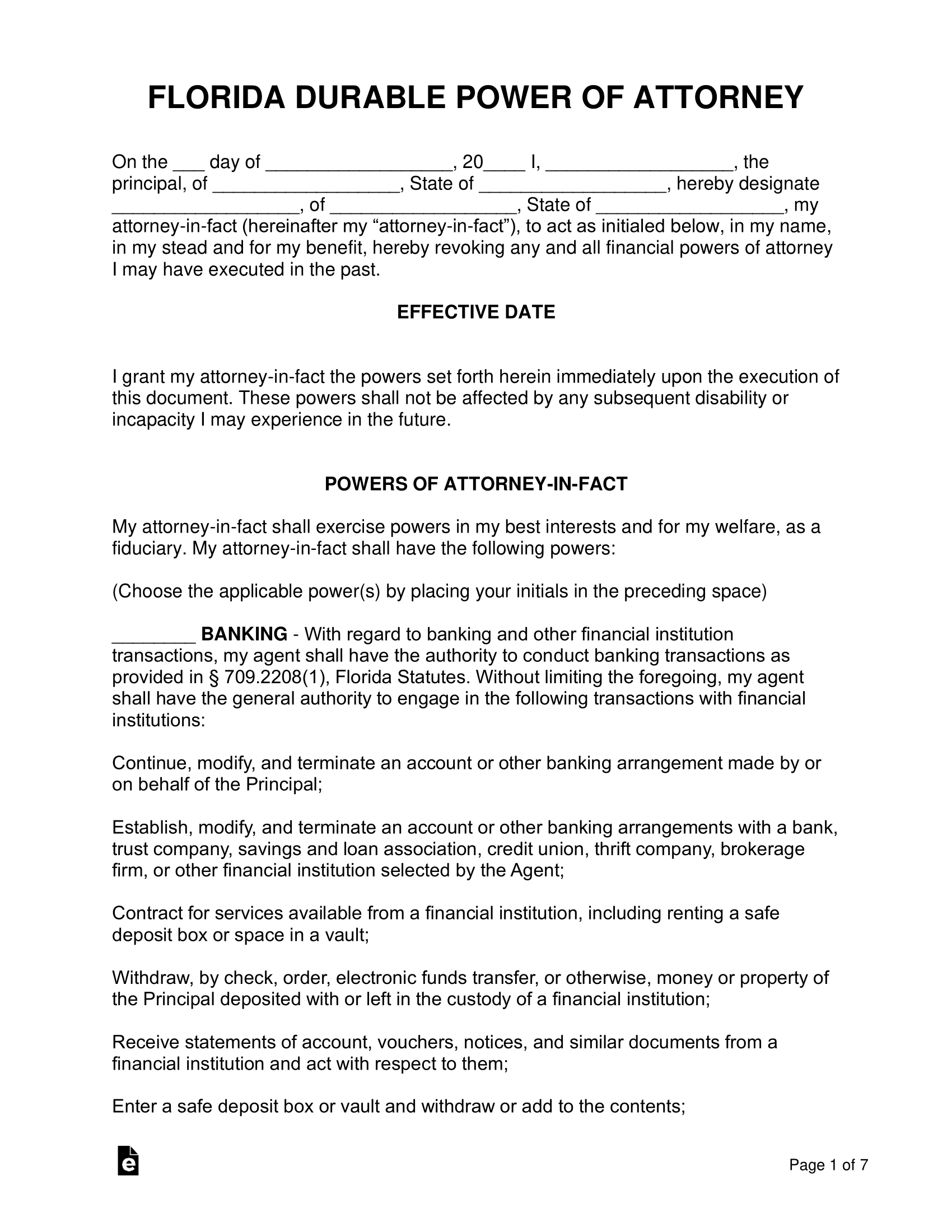
[FL] [FL] Can a POA be signed in multiple states?
If you’re handling a Power of Attorney (POA) for your grandmother in Florida, and you’re the primary agent (living in Maryland) with a possible second agent in Illinois, here’s how the signing usually works:
- Check Florida law first. The form and signing requirements depend on Florida law because the principal — your grandmother — lives there. Florida generally requires:
• The principal’s signature in front of two witnesses and a notary.
• Sometimes the agents’ signatures are also notarized, depending on whether the POA form calls for it. - The agents don’t have to sign at the same time or in the same place. In most cases, the agents can sign separately and mail the pages back. So your second agent in Illinois can sign, notarize (if required), and mail the signed page to you or whoever is finalizing the POA.
- Make sure it’s all assembled properly. When you submit the POA, the full document should include your grandmother’s notarized signature, the required witness signatures, and both agents’ properly signed and notarized pages if the form requires that.
- Practical tip: Banks, title companies, and other third parties may want to see the original, so make sure the final document is one complete, clear version with all signatures attached.
Key point: The principal’s signing must comply with Florida’s formalities — the agents’ signatures can typically be done out-of-state as long as they meet the notarization/witnessing requirements on the form.
0
Durable Power of Attorney
Full Conversation
If the 2nd agent on a POA lives in a different state, can they sign and send it back to us and then we go forth and sign?
I understand the importance of ensuring all parties can sign the Power of Attorney (POA) document. Is the POA document valid in both states?
No
Have you checked if there are any specific requirements or restrictions for signing a POA document across state lines?
No
Is there anything else the Lawyer should know before I connect you? Rest assured they’ll be able to help with your Power of Attorney issue.
Both agents live in different states from the person.
Hello, my name is Andres Sanchez and I am an attorney with 20 years of experience. What states are involved?
So my grandmother, who the POA is about, lives in Florida. I, the 1st agent, live in Maryland (currently in Florida visiting to set everything up), and the possible 2nd agent lives in Illinois.
If you’re handling a Power of Attorney (POA) for your grandmother in Florida, and you’re the primary agent (living in Maryland) with a possible second agent in Illinois, here’s how the signing usually works:
- Check Florida law first. The form and signing requirements depend on Florida law because the principal — your grandmother — lives there. Florida generally requires:
• The principal’s signature in front of two witnesses and a notary.
• Sometimes the agents’ signatures are also notarized, depending on whether the POA form calls for it. - The agents don’t have to sign at the same time or in the same place. In most cases, the agents can sign separately and mail the pages back. So your second agent in Illinois can sign, notarize (if required), and mail the signed page to you or whoever is finalizing the POA.
- Make sure it’s all assembled properly. When you submit the POA, the full document should include your grandmother’s notarized signature, the required witness signatures, and both agents’ properly signed and notarized pages if the form requires that.
- Practical tip: Banks, title companies, and other third parties may want to see the original, so make sure the final document is one complete, clear version with all signatures attached.
Key point: The principal’s signing must comply with Florida’s formalities — the agents’ signatures can typically be done out-of-state as long as they meet the notarization/witnessing requirements on the form.
Can you tell me if Florida requires a notary for agents?
Yes — Florida law imposes specific notarization and witnessing requirements, but these apply only to the principal (your grandmother), not to the agents.
Can you verify for me what the requirements are for the 2 witnesses in the state of Florida for POA, medical POA, and advance directive?
Here are the verified Florida statutory requirements for witnesses on Powers of Attorney (POA), Medical POA (Health Care Surrogate), and Advance Directives:
-
Financial and Durable POA (Chapter 709)
• The principal’s signature must be made in the physical presence of two subscribing adult witnesses.
• That same signature must be acknowledged before a notary public.
• There are no statutory restrictions on who the witnesses can be unless the form states otherwise. -
Health Care Surrogate / Medical POA (Chapter 765.202)
• Must be signed by the principal in the presence of two subscribing adult witnesses.
• At least one witness must NOT be the principal’s spouse or a blood relative.
• The designated health care surrogate cannot serve as a witness.
• Notarization is not required unless the form specifically requests it. -
Advance Directive
• Must be signed by the principal in front of two adult witnesses.
• At least one witness must not be the principal’s spouse or blood relative.
• No notarization is required.
Can you tell me if Florida requires any paperwork for dealing with someone’s car loan after they pass? Is a transfer-on-death valid?
Yes — here’s how it works in Florida:
Car Loan After Death
• Any outstanding car loan remains. The lender keeps its lien on the vehicle.
• The lender can repossess or require payment from the estate, a co-signer, or the inheritor who takes ownership.
Estate’s Role
• If there's no co-signer, the estate must pay the loan, or the lender may repossess.
Co-signer Liability
• A co-signer is fully responsible for the balance.
Taking Over the Loan
• An inheritor may need to refinance or assume the loan.
Transfer-on-Death (TOD) for Vehicles
Florida allows a transfer-on-death designation through a beneficiary form under Florida Statute 319.28.
Upon death, ownership transfers automatically to the named beneficiary, who must submit:
• A death certificate
• The existing title
• A new title application
Important: The lien stays attached. The beneficiary inherits both the vehicle and the debt.
If titled solely to the decedent, heirs or the personal representative may transfer title using an affidavit, the death certificate, and a title application.
Thank you. So I would be taking on the loan and I live in Maryland. Would I need to have the title in Florida, or can I take it to the DMV in Maryland?
Yes — you would become responsible for the loan and can transfer the Florida title to Maryland. I am glad I could provide guidance. I hope everything works out for you, and please request me on the website if you have any more questions.
Thank you.
You're welcome.
Disclaimer
By messaging AskaLawyer.com, you agree to our Terms and have read our Privacy Policy.
The information provided on AskaLawyer.com is for general informational purposes only and does not constitute legal advice. While we strive to ensure the accuracy and timeliness of the information presented, we make no guarantees regarding its completeness or applicability to your specific circumstances.
Use of this website does not create an attorney-client relationship between you and AskaLawyer.com or any of its attorneys. Communications through this website, including any responses from attorneys, are not privileged or confidential. For advice tailored to your individual situation, we recommend consulting a licensed attorney in your jurisdiction.
AskaLawyer.com disclaims any liability for actions taken or not taken based on the content of this site. We are not responsible for any third-party content that may be accessed through this website. Reliance on any information provided herein is solely at your own risk.