[AZ] Do I need an Affidavit of Property Value for a Beneficiary Deed form?

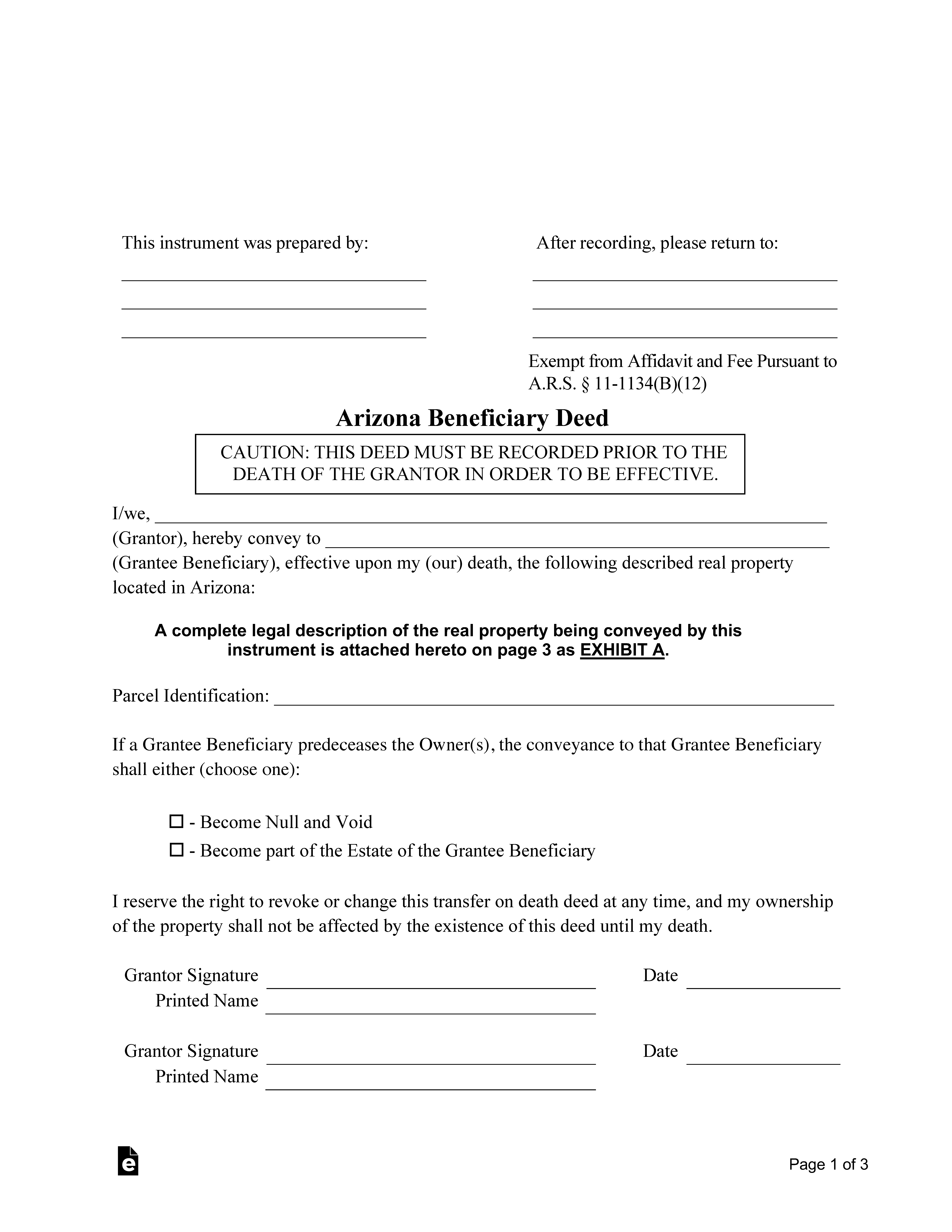
I have completed the Arizona Beneficiary Deed form. The form says, "Exempt from Affidavit and fee." But when filling out the online form, it directed me to the Affidavit of Property Value. Must I complete the affidavit? It doesn't seem to apply. Also, is the AZ Beneficiary Deed revocable? It doesn't say.

13

4

Brandon
Brandon

16,155 satisfied customers

View context
Solved

First, about the Affidavit of Property Value:

In Arizona, generally an Affidavit of Property Value is required when a deed is recorded, but there are clear exceptions — and one major exception is when you are recording a Beneficiary Deed (sometimes called a Transfer on Death or TOD deed).

Arizona Revised Statutes § 11-1134 outlines the exemptions, and specifically says that a transfer under a Beneficiary Deed is exempt from needing an Affidavit of Property Value. You are absolutely right — if your form says “Exempt from Affidavit and fee,” and you're not selling or transferring the property for money, you should not need to complete the affidavit.

Sometimes, online systems or e-filing portals are set up broadly and automatically ask about the affidavit because most other deeds do require it. But for you, based on what you’re doing, you should be able to mark it as "Exempt" or write "Exempt per A.R.S. § 11-1134(B)(8)" if they make you fill something out.

Bottom line: You do not need to submit an Affidavit of Property Value for recording your Beneficiary Deed.

Now, your second (very important) question:

Is an Arizona Beneficiary Deed revocable?

The answer is yes, absolutely! In Arizona, a Beneficiary Deed is revocable at any time before death. This is true even if the deed itself doesn’t explicitly say “revocable.” Under Arizona law (specifically, A.R.S. § 33-405), a property owner who records a Beneficiary Deed retains full ownership rights during their lifetime and can revoke or change the deed whenever they want.

There are two common ways people revoke or change it:

  1. Record a revocation form (there is a specific Revocation of Beneficiary Deed form you can record).
  2. Record a new Beneficiary Deed that names new beneficiaries — this automatically revokes the earlier one if it conflicts.

Nothing becomes final until your deaths. Up until then, you and your husband have total control.

Finally, to your last and very important point:

Will this pass the property to your heirs without probate?

Yes, that's the purpose of a Beneficiary Deed. When both you and your husband pass away, your house will transfer directly to your four children without going through the probate court process. They will need to record a death certificate with the county recorder’s office to complete the transfer, but no probate court proceedings will be necessary for the house itself.

This is one of the simplest and most cost-effective ways in Arizona to avoid probate for real estate.

0

Arizona Beneficiary Deed

Full Conversation


Lexi

Lexi, Chatbot

I understand your concern about the Affidavit of Property Value. Have you already completed the Arizona Beneficiary Deed form?

Yes.

Lexi

Lexi, Chatbot

Are you looking to make the Beneficiary Deed revocable or irrevocable?

Revocable.

Lexi

Lexi, Chatbot

Is there anything else the Lawyer should know before I connect you? Rest assured they’ll be able to help with your Beneficiary Deed.

Will this pass the property to my heirs without probate?

Brandon

Brandon

Hi there and welcome to Ask a Lawyer. My name is Brandon and I'm an attorney. I'd be happy to help you out today. Please note that this discussion is for guidance only and does not constitute an Attorney-Client Relationship. My answers and comments should not be considered legal advice. Please also note that I am human, that I often need to research your answer to give you an accurate response, and that I work with other customers and get up from time to time. So please be patient while waiting for a response. If more than 30 minutes have passed, please feel free to reach out.

Trying to record a transfer on death beneficiary form to pass our house to our four kids upon our death (husband and wife). The form says the affidavit of property value is not required and the affidavit doesn't look like it would apply. In fact, it is impossible to fill out. Do I need an affidavit in Arizona? The eform doesn't say the deed is revocable. Is it?

Brandon

Brandon

First, about the Affidavit of Property Value:

In Arizona, generally an Affidavit of Property Value is required when a deed is recorded, but there are clear exceptions — and one major exception is when you are recording a Beneficiary Deed (sometimes called a Transfer on Death or TOD deed).

Arizona Revised Statutes § 11-1134 outlines the exemptions, and specifically says that a transfer under a Beneficiary Deed is exempt from needing an Affidavit of Property Value. You are absolutely right — if your form says “Exempt from Affidavit and fee,” and you're not selling or transferring the property for money, you should not need to complete the affidavit.

Sometimes, online systems or e-filing portals are set up broadly and automatically ask about the affidavit because most other deeds do require it. But for you, based on what you’re doing, you should be able to mark it as "Exempt" or write "Exempt per A.R.S. § 11-1134(B)(8)" if they make you fill something out.

Bottom line: You do not need to submit an Affidavit of Property Value for recording your Beneficiary Deed.

Now, your second (very important) question:

Is an Arizona Beneficiary Deed revocable?

The answer is yes, absolutely! In Arizona, a Beneficiary Deed is revocable at any time before death. This is true even if the deed itself doesn’t explicitly say “revocable.” Under Arizona law (specifically, A.R.S. § 33-405), a property owner who records a Beneficiary Deed retains full ownership rights during their lifetime and can revoke or change the deed whenever they want.

There are two common ways people revoke or change it:

  1. Record a revocation form (there is a specific Revocation of Beneficiary Deed form you can record).
  2. Record a new Beneficiary Deed that names new beneficiaries — this automatically revokes the earlier one if it conflicts.

Nothing becomes final until your deaths. Up until then, you and your husband have total control.

Finally, to your last and very important point:

Will this pass the property to your heirs without probate?

Yes, that's the purpose of a Beneficiary Deed. When both you and your husband pass away, your house will transfer directly to your four children without going through the probate court process. They will need to record a death certificate with the county recorder’s office to complete the transfer, but no probate court proceedings will be necessary for the house itself.

This is one of the simplest and most cost-effective ways in Arizona to avoid probate for real estate.

That's very helpful. One more - My father just passed away leaving everything to his wife/my mother. I am the executor of both their wills. Since everything goes to mom, do I need to file his will with the court? Do I need to remove him from their properties somehow before I file beneficiary deeds for mom's beneficiaries?

Brandon

Brandon

First question: Do you need to file your father's will with the court?

In Arizona (and in most other states), even if a full probate is not needed because everything is passing to the surviving spouse (your mom), you still typically need to file your father's original will with the probate court in the county where he lived.

Arizona law (A.R.S. § 14-2517) says that any person in possession of an original will must deliver it to the court within a "reasonable time" after learning of the death — even if you don’t think you’ll need probate. It’s a simple filing just to place it "on record."

You are not necessarily opening a probate case just by filing the will. Filing the will protects everyone later and ensures that the court has it on file if anything unexpected comes up with property, bank accounts, or title issues.

So yes, you should go ahead and file your father’s will with the court — even if there is no immediate probate action needed.

Second question: Do you need to "remove" your father's name from property titles before filing a new Beneficiary Deed for your mom?

Yes — you will need to update the title on any jointly owned real estate where your father was named, so that the property is now fully in your mother's name alone before she can record a new Beneficiary Deed.

If they owned the property together (for example, as "husband and wife" or "community property with right of survivorship" or "joint tenants with right of survivorship"), it’s relatively simple:

  • You would typically record an Affidavit of Surviving Spouse (sometimes called an Affidavit of Death of Joint Tenant) with the County Recorder's Office.
  • Along with the affidavit, you would record an original or certified copy of your father's death certificate.

This filing clears his name off the title officially and vests the full ownership in your mom’s name alone.

Only once that is done can your mom properly sign and file a Beneficiary Deed listing her own beneficiaries (for example, her children) to avoid probate when she passes.

So helpful! Thanks so much.

Brandon

Brandon

You’re very welcome. Feel free to add me to your favorites. Whenever you have a new question, you can start a new question with me here or request me by name, @BrandonEsq. Thanks for using Ask a Lawyer.

Brandon

Brandon

16,155 satisfied customers

Brandon
Welcome! Have a similar question?

5 lawyers online now

Jessica B
Jessica B

Attorney

4.75 (29,480)

[OH] How do I file a small estate affidavit for transferring stock?

12

3

Answered 1 week ago

Disclaimer


By messaging AskaLawyer.com, you agree to our Terms and have read our Privacy Policy.

The information provided on AskaLawyer.com is for general informational purposes only and does not constitute legal advice. While we strive to ensure the accuracy and timeliness of the information presented, we make no guarantees regarding its completeness or applicability to your specific circumstances.

Use of this website does not create an attorney-client relationship between you and AskaLawyer.com or any of its attorneys. Communications through this website, including any responses from attorneys, are not privileged or confidential. For advice tailored to your individual situation, we recommend consulting a licensed attorney in your jurisdiction.

AskaLawyer.com disclaims any liability for actions taken or not taken based on the content of this site. We are not responsible for any third-party content that may be accessed through this website. Reliance on any information provided herein is solely at your own risk.

Ask a Lawyer Logo
Ask a Lawyer Logo
Intake Questions
Step of 3
Loading...
Loading...

How do you like to pay?

By proceeding with payment, you agree to our Terms and Privacy Policy. You authorize us to charge $ today and $ thereafter until canceled. You may cancel anytime in the My Account section to stop future charges.

Total Due:

After purchasing, your chat will begin with an attorney.

By proceeding with payment, you agree to our Terms and Privacy Policy. You authorize us to charge $ today and $ thereafter until canceled. You may cancel anytime in the My Account section to stop future charges.

Total Due:

After purchasing, your chat will begin with an attorney.

It looks like you already have an account with Ask a Lawyer.

We have sent you a magic link to . Click the link in your email to sign in and continue your chat.

spin

Step of 6 •

You'll receive an email at as soon as the lawyer joins the conversation 🙏🏻😊

Over 90% of lawyers connect within 5 minutes. If you're not online at that moment, don't worry — the lawyer will reply to your message while you're away.

You're also welcome to stay in the chat while waiting to be connected 💬✨

Waiting for lawyer