[DE] [DE] How do I set up an LLC?

Setting up an LLC in Delaware — what are the steps? I want to start a freelance business.

13

4

Brandon
Brandon

16,155 satisfied customers

View context
Solved

Step 1: Forming Your Delaware LLC

Choose a Business Name
Your LLC name must be distinguishable from others registered in Delaware and must include “Limited Liability Company,” “LLC,” or “L.L.C.” Check name availability using the Delaware Division of Corporations website (corp.delaware.gov).

Appoint a Registered Agent
Delaware requires every LLC to have a registered agent with a physical address in Delaware. This person or service receives official legal documents on behalf of your LLC. You can use a registered agent service (common for out-of-state business owners) for around $50–$150 per year.

File a Certificate of Formation
This is the formal document that creates your LLC. File online or by mail through the Delaware Division of Corporations. Filing fee: $90. You’ll list your business name and registered agent — no need to include members or business purpose unless desired.

Draft an LLC Operating Agreement
Not required by Delaware law, but strongly recommended. This internal document lays out ownership percentages, how decisions will be made, and what happens if a member leaves. Even if you're a single-member LLC, it can protect you by demonstrating that you’re running a legitimate business.

Obtain an EIN from the IRS
You’ll need this Employer Identification Number to open a bank account, hire workers, and file taxes. Apply for free online through the IRS EIN application portal.

Step 2: Ongoing Legal and Compliance Requirements
Once the LLC is formed, you’re not done — you have a few annual and legal duties to stay compliant.

Delaware Franchise Tax
All LLCs must pay an annual $300 franchise tax, due by June 1 every year. Failure to pay results in penalties and potential administrative dissolution.

Registered Agent Service
If you're not physically located in Delaware, you'll need to keep this service current year to year.

Business License
If you're operating your freelance business from another state (like where you live or work), you’ll need to register your Delaware LLC as a foreign LLC in that state and get a local business license. Delaware doesn’t require a state-level general business license, but your local city or county may.

Comply with Federal and State Laws

  • Employment laws: If you ever hire help, even freelancers, be aware of IRS classification rules and local labor laws. For employees, ensure compliance with payroll taxes, workers' comp, and wage laws.
  • Data privacy laws: Depending on your industry (especially if you're in tech, health, or finance), you might need to follow specific privacy or confidentiality regulations.
  • Professional licensing: If your freelance work involves regulated services (legal, health, finance, etc.), you may need additional certifications or licenses.

Step 3: Tax Obligations
How your LLC is taxed will depend on how you elect to be treated and where you're physically doing business.

Federal Taxes
By default, a single-member LLC is a “disregarded entity,” meaning you’ll report business income and expenses on Schedule C of your personal tax return. No corporate-level federal tax unless you elect to be taxed as an S-corp or C-corp.

Self-Employment Taxes
You’ll owe self-employment tax (Social Security and Medicare) on your net earnings — currently 15.3% on your first ~$160K in net income. Consider quarterly estimated payments to the IRS using Form 1040-ES.

State Taxes
If you live outside Delaware, you’ll likely owe income tax and/or business taxes in your home state — Delaware’s tax savings generally only benefit larger corporations or those with complex structures. Delaware doesn’t tax out-of-state income, but you may not avoid taxes in your own state just by registering there.

Sales Tax
Freelancers offering services usually don’t collect sales tax, but this depends on your state and the nature of the service. For example, graphic design may be taxable in some states but not others.

0

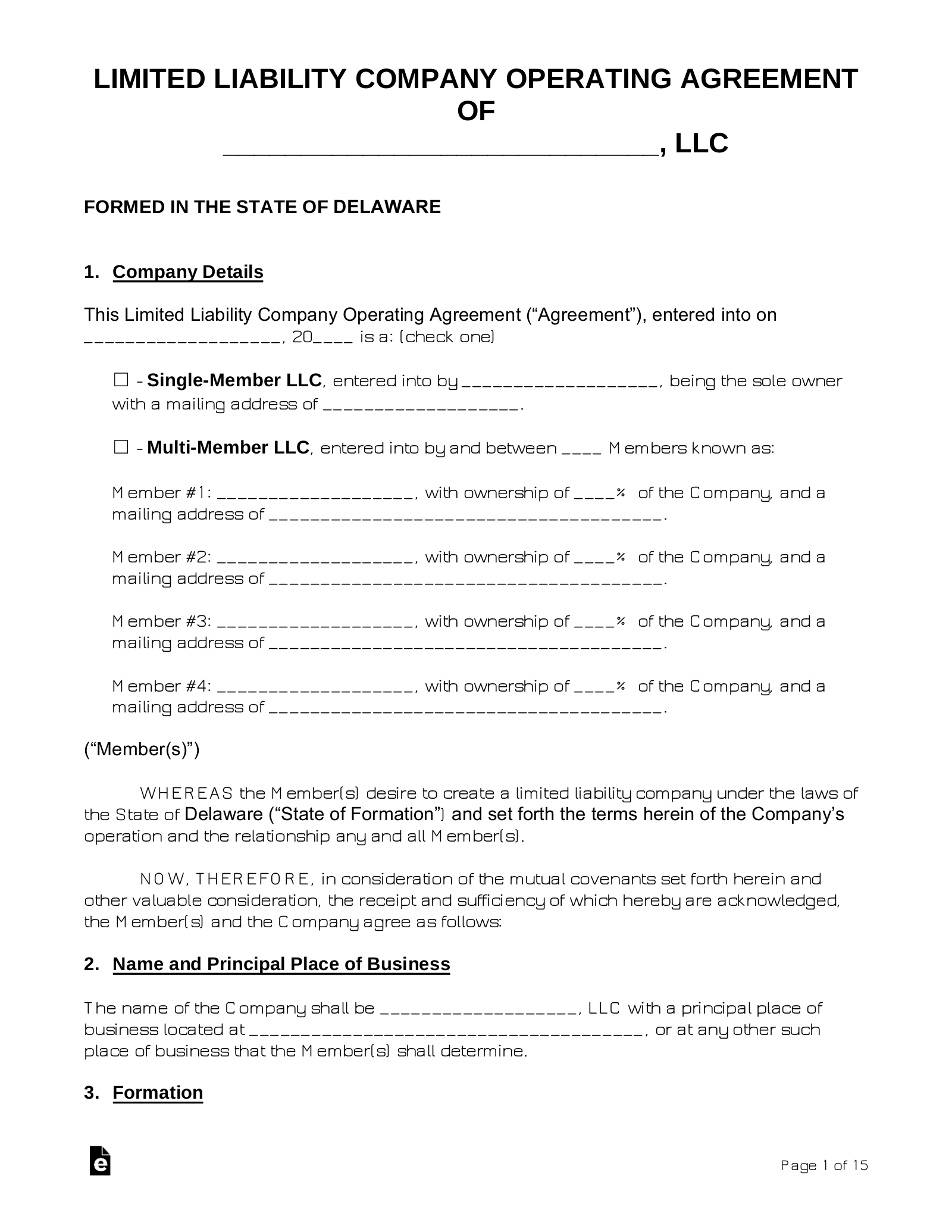
LLC Operating Agreement

Full Conversation


Setting up an LLC in Delaware — what are the steps? I want to start a freelance business.

Lexi

Lexi, Chatbot

Setting up an LLC in Delaware can be a great choice for your freelance business. Have you already decided on a name for your LLC?

I don’t know.

Lexi

Lexi, Chatbot

Are you familiar with the requirements for registered agents in Delaware for LLC formation?

I don't know.

Lexi

Lexi, Chatbot

Is there anything else the corporate lawyer should know before I connect you? Rest assured they’ll be able to help with your LLC formation.

Yes

Brandon

Brandon

Hi there and welcome to AskaLawyer. My name is Brandon and I'm an attorney. I'd be happy to help you out today.

Please note that this discussion is for guidance only and does not constitute an attorney-client relationship. My answers and comments should not be considered legal advice.

Please also note that I am human, that I often need to research your answer to give you an accurate response, and that I work with other customers and get up from time to time. So please be patient while waiting for a response. If more than 30 minutes have passed, please feel free to reach out.

Brandon

Brandon

What, if any, steps have you taken?

I’m just getting started. I’d like to understand the compliance and legal requirements for an LLC, including tax obligations, employment laws and regulations, and other state or federal regulations.

Brandon

Brandon

Step 1: Forming Your Delaware LLC

Choose a Business Name
Your LLC name must be distinguishable from others registered in Delaware and must include “Limited Liability Company,” “LLC,” or “L.L.C.” Check name availability using the Delaware Division of Corporations website (corp.delaware.gov).

Appoint a Registered Agent
Delaware requires every LLC to have a registered agent with a physical address in Delaware. This person or service receives official legal documents on behalf of your LLC. You can use a registered agent service (common for out-of-state business owners) for around $50–$150 per year.

File a Certificate of Formation
This is the formal document that creates your LLC. File online or by mail through the Delaware Division of Corporations. Filing fee: $90. You’ll list your business name and registered agent — no need to include members or business purpose unless desired.

Draft an LLC Operating Agreement
Not required by Delaware law, but strongly recommended. This internal document lays out ownership percentages, how decisions will be made, and what happens if a member leaves. Even if you're a single-member LLC, it can protect you by demonstrating that you’re running a legitimate business.

Obtain an EIN from the IRS
You’ll need this Employer Identification Number to open a bank account, hire workers, and file taxes. Apply for free online through the IRS EIN application portal.

Step 2: Ongoing Legal and Compliance Requirements
Once the LLC is formed, you’re not done — you have a few annual and legal duties to stay compliant.

Delaware Franchise Tax
All LLCs must pay an annual $300 franchise tax, due by June 1 every year. Failure to pay results in penalties and potential administrative dissolution.

Registered Agent Service
If you're not physically located in Delaware, you'll need to keep this service current year to year.

Business License
If you're operating your freelance business from another state (like where you live or work), you’ll need to register your Delaware LLC as a foreign LLC in that state and get a local business license. Delaware doesn’t require a state-level general business license, but your local city or county may.

Comply with Federal and State Laws

  • Employment laws: If you ever hire help, even freelancers, be aware of IRS classification rules and local labor laws. For employees, ensure compliance with payroll taxes, workers' comp, and wage laws.
  • Data privacy laws: Depending on your industry (especially if you're in tech, health, or finance), you might need to follow specific privacy or confidentiality regulations.
  • Professional licensing: If your freelance work involves regulated services (legal, health, finance, etc.), you may need additional certifications or licenses.

Step 3: Tax Obligations
How your LLC is taxed will depend on how you elect to be treated and where you're physically doing business.

Federal Taxes
By default, a single-member LLC is a “disregarded entity,” meaning you’ll report business income and expenses on Schedule C of your personal tax return. No corporate-level federal tax unless you elect to be taxed as an S-corp or C-corp.

Self-Employment Taxes
You’ll owe self-employment tax (Social Security and Medicare) on your net earnings — currently 15.3% on your first ~$160K in net income. Consider quarterly estimated payments to the IRS using Form 1040-ES.

State Taxes
If you live outside Delaware, you’ll likely owe income tax and/or business taxes in your home state — Delaware’s tax savings generally only benefit larger corporations or those with complex structures. Delaware doesn’t tax out-of-state income, but you may not avoid taxes in your own state just by registering there.

Sales Tax
Freelancers offering services usually don’t collect sales tax, but this depends on your state and the nature of the service. For example, graphic design may be taxable in some states but not others.

I would like to set up an LLC in Delaware mostly because I plan on being location independent. So, if I have a remote business, and reside in Michigan or any other state, how could I best avoid any negative tax implications? How would the IRS know that I’m doing business in that state?

Brandon

Brandon

Even if your LLC is formed in Delaware, most states (including Michigan) will expect you to register as a foreign LLC and pay taxes if:

  • You’re physically working from that state.
  • You’re regularly meeting with clients in that state (even online).
  • You’re earning income tied to services performed while present in the state.

In short, if you reside or work from Michigan, the state has the right to tax your LLC’s income, even if the entity is technically registered in Delaware.

How Would the IRS or State Know Where You're Operating From?
They don't always know automatically, but it can become obvious if:

  • Your tax return shows a Michigan address.
  • You use a Michigan bank account or pay for business expenses there.
  • Your IP address or devices consistently show Michigan activity.
  • Your business licenses, utilities, or rent are tied to Michigan.
  • You apply for health insurance or register to vote there.
  • You receive 1099s or client payments with Michigan as the service address.

If Michigan audits you, they’ll look at these indicators to decide if your LLC is “doing business” there. It’s not about where your LLC is registered — it’s about where the activity is taking place.

How to Minimize Tax and Legal Burdens While Remaining Compliant

Option 1: Keep a True Nomad Status (No Domicile State)
This is possible but difficult to pull off. You’d have to give up all ties to any one state (no residence, driver’s license, voter registration, etc.), use a mail forwarding service in a tax-free state (e.g., Florida, Texas, South Dakota), form your LLC in Delaware or another favorable state, and travel continuously or live abroad.

Option 2: Accept Residency but Use Smart Structuring
If you expect to live in a state like Michigan for part or most of the year, this route is more realistic:

  • Form your LLC in Delaware and keep a Delaware registered agent and address.
  • Register your Delaware LLC as a “foreign LLC” in Michigan if you reside or work there more than temporarily.
  • Report LLC income on your Michigan state return, or whatever state you reside in.
  • Avoid double taxation — Delaware doesn’t tax out-of-state LLC income, so you’d only pay the $300/year franchise tax there.
  • Use a separate business mailing address, virtual mailbox, or co-working space if needed for privacy.

This structure gives you compliance, legitimacy, and mobility while still letting you live where you need to live without hiding from tax obligations.

What About Federal Taxes?
Regardless of state, the IRS will tax your LLC based on how it’s structured:

  • Single-member LLC: Taxed as a sole proprietorship by default. Report income on Schedule C of your personal return.
  • Multi-member LLC: Defaults to a partnership, or you can elect S-Corp/C-Corp status.

No matter what, the IRS expects accurate reporting of where you earned the income and how much. Residency affects your state return, not federal.

Realistic and Legal Tax-Saving Tips

  • Limit your time in high-tax states to under 183 days/year if you’re traveling.
  • Use a tax-friendly state (like Florida or Texas) as your “domicile” if you’re going nomad.
  • Keep clear records of where you are when you’re working.
  • Deduct travel, home office, and business expenses legally to reduce your federal tax burden.
 
 
Brandon

Brandon

16,155 satisfied customers

Brandon
Welcome! Have a similar question?

5 lawyers online now

Disclaimer


By messaging AskaLawyer.com, you agree to our Terms and have read our Privacy Policy.

The information provided on AskaLawyer.com is for general informational purposes only and does not constitute legal advice. While we strive to ensure the accuracy and timeliness of the information presented, we make no guarantees regarding its completeness or applicability to your specific circumstances.

Use of this website does not create an attorney-client relationship between you and AskaLawyer.com or any of its attorneys. Communications through this website, including any responses from attorneys, are not privileged or confidential. For advice tailored to your individual situation, we recommend consulting a licensed attorney in your jurisdiction.

AskaLawyer.com disclaims any liability for actions taken or not taken based on the content of this site. We are not responsible for any third-party content that may be accessed through this website. Reliance on any information provided herein is solely at your own risk.

Ask a Lawyer Logo
Ask a Lawyer Logo
Intake Questions
Step of 3
Loading...
Loading...

How do you like to pay?

By proceeding with payment, you agree to our Terms and Privacy Policy. You authorize us to charge $ today and $ thereafter until canceled. You may cancel anytime in the My Account section to stop future charges.

Total Due:

After purchasing, your chat will begin with an attorney.

By proceeding with payment, you agree to our Terms and Privacy Policy. You authorize us to charge $ today and $ thereafter until canceled. You may cancel anytime in the My Account section to stop future charges.

Total Due:

After purchasing, your chat will begin with an attorney.

It looks like you already have an account with Ask a Lawyer.

We have sent you a magic link to . Click the link in your email to sign in and continue your chat.

spin

Step of 6 •

You'll receive an email at as soon as the lawyer joins the conversation 🙏🏻😊

Over 90% of lawyers connect within 5 minutes. If you're not online at that moment, don't worry — the lawyer will reply to your message while you're away.

You're also welcome to stay in the chat while waiting to be connected 💬✨

Waiting for lawyer