[FL] [FL] I was in a car accident and the other driver is demanding $100k for injuries. Is it legal for my insurance company to make me pay out-of-pocket for part of the settlement?
So generally speaking — even in 50/50 fault accidents, insurance companies may choose to settle injury claims to avoid litigation costs, especially if there’s any potential exposure. Florida follows a comparative negligence rule, so the other driver can still recover 50% of her damages. Your insurer is likely offering a settlement within your policy limits to avoid the cost and risk of a lawsuit.
Unfortunately, insurance premiums can increase anytime your insurer pays a claim on your behalf, even if fault is shared or you had no damages. This is standard across the industry and not necessarily a judgment of guilt.
If the injured party rejects the settlement and sues, and a jury awards more than your $100k liability limit, you could be personally responsible for the excess. However, your insurer must protect you from that by acting reasonably to settle within your policy limits. If they fail to do that and you’re hit with an excess judgment, they may be liable for bad faith, not you.
Your insurer has the contractual right to settle claims within your policy limits without your approval. As long as the settlement stays within those limits, you don’t need to contribute anything unless you personally choose to pay more to avoid court, which is rare.
0
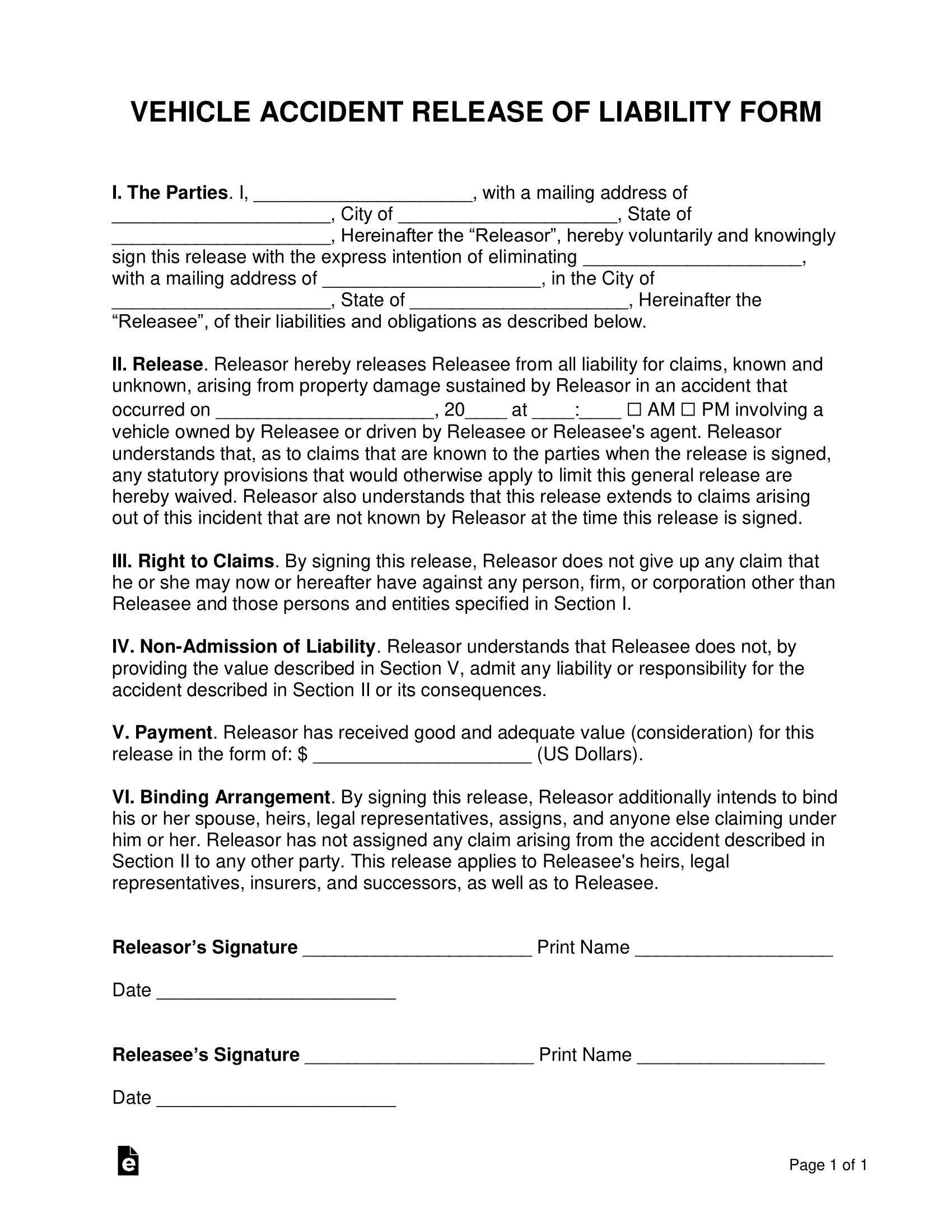
Vehicle Accident Release of Liability (Settlement Agreement)
Full Conversation
I was involved in a car accident about a year ago. Minor damage to the other vehicle. I had no damage to my vehicle but notified my insurance about the accident. About a month later, the other party filed a claim for damage to their car as well as retaining a personal injury lawyer for injuries sustained, and I was told not to speak to her again.
I’m sorry to hear about your car accident. Have you been in contact with your insurance company regarding the claim filed by the other party?
A demand letter was sent to my insurance from the other party’s lawyer. At the time of the accident, it was determined to be 50/50 fault and my insurance did not pay damages for her vehicle. Now, her lawyer is demanding $100k for “injuries” sustained in the accident. She is claiming permanent disabling disability, despite leaving the scene of the accident uninjured and telling the 911 operator she was not injured. She waited about 10 days to go for a medical evaluation for her pain.
Do you have any documentation or records from the accident that you can provide to the lawyer?
That’s done. Everything that was requested is already done.
Is there anything else the lawyer should know before I connect you? Rest assured they’ll be able to help with your personal injury claim.
Yes.
Hello! My name is Michael, and I’m an attorney ready to help! Your responses matter to me, so I only need a few minutes to review and respond to each of your posts. Are you in contact with your insurance adjuster?
I am in contact with my insurance adjuster. She told me that they are likely to give this lady some money after negotiating with her attorney. But, if this was equal fault on both of our parts, why is my insurance paying her money? I had no injury or damage. And this will likely raise my insurance premium a lot.
I hear you! Did your insurance company determine who was at fault?
When the accident happened in Aug 2024, they reviewed pictures of our cars and statements and decided it was equal fault due to a dispute over a lane change. We both merged into the same lane at the same time. They couldn’t determine fault and there were no witnesses, video, or any other evidence. Just her word against mine. I told the insurance adjuster at the time I had no damage or injury, and that I thought we “merged into the same lane at the same time and collided.” The damage to her car was only a minor dent to the door, which my insurance company did not pay for. She claimed no injury at the scene, didn’t want police to come, so I just self-reported to my insurance and the online Florida Highway Patrol form, and didn’t file a claim at all.
Understood! Now that I have this info, what is your legal question for me?
First — my insurance adjuster indicated that they intend to offer something around $70k, with my coverage being $100k. But this will absolutely affect my insurance for several years. How can they do that? This was determined to be an equal fault accident and the other party is injured, not me.
Second — the adjuster also told me that they typically offer low and negotiate, but if the other party chooses to reject that offer, I might be liable to pay the difference between what they offer ($70k) and what they are demanding ($100k) out of my own pocket. Even though my coverage goes to $100k. I’m like, that’s a lot of money! Why would I have to pay this? She said, “To keep yourself out of court.”
So generally speaking — even in 50/50 fault accidents, insurance companies may choose to settle injury claims to avoid litigation costs, especially if there’s any potential exposure. Florida follows a comparative negligence rule, so the other driver can still recover 50% of her damages. Your insurer is likely offering a settlement within your policy limits to avoid the cost and risk of a lawsuit.
Unfortunately, insurance premiums can increase anytime your insurer pays a claim on your behalf, even if fault is shared or you had no damages. This is standard across the industry and not necessarily a judgment of guilt.
If the injured party rejects the settlement and sues, and a jury awards more than your $100k liability limit, you could be personally responsible for the excess. However, your insurer must protect you from that by acting reasonably to settle within your policy limits. If they fail to do that and you’re hit with an excess judgment, they may be liable for bad faith, not you.
Your insurer has the contractual right to settle claims within your policy limits without your approval. As long as the settlement stays within those limits, you don’t need to contribute anything unless you personally choose to pay more to avoid court, which is rare.
No, that’s the answer I needed to hear. The adjuster started asking me a ton of questions about things that were reasonable. She asked me if I had an umbrella policy, if I was working for a company at the time of the accident, or would there be any other coverage for any reason that I could think of.
But then she started delving into my personal wealth — asking if I own property other than my home, if I have retirement accounts, IRAs, etc., and if I had cash. I thought that was weird but it took me a few minutes to realize that she seemed to be sizing me up. I stopped answering, but I had already told her a lot. It made me feel really bad afterwards.
I’m so sorry about that! It seems the adjuster was trying to determine if you have personal assets that could be at risk if a settlement exceeds your policy limits. This is common in high-value claims, but it can feel intrusive. You were correct to stop answering; you are not required to disclose that type of financial information.
Ok. One more question and then I think that is it. But should I trust her though? I’m not sure what side she is on.
Also… am I able to come back here to see if you can answer more questions if they come up? I like your responses. I’m happy to pay for the help.
Sure thing! I would trust her in this case, though she ultimately works for the insurance carrier. They still want to avoid costly payouts and have to balance that. Also, be sure to save this URL and you can come back to me!
Ok. Thanks.
Disclaimer
By messaging AskaLawyer.com, you agree to our Terms and have read our Privacy Policy.
The information provided on AskaLawyer.com is for general informational purposes only and does not constitute legal advice. While we strive to ensure the accuracy and timeliness of the information presented, we make no guarantees regarding its completeness or applicability to your specific circumstances.
Use of this website does not create an attorney-client relationship between you and AskaLawyer.com or any of its attorneys. Communications through this website, including any responses from attorneys, are not privileged or confidential. For advice tailored to your individual situation, we recommend consulting a licensed attorney in your jurisdiction.
AskaLawyer.com disclaims any liability for actions taken or not taken based on the content of this site. We are not responsible for any third-party content that may be accessed through this website. Reliance on any information provided herein is solely at your own risk.