[TN] Is divorce a simple matter of completing forms?
Hi again!
The forms are likely all you need to file for divorce in Williamson County, Tennessee. However, divorce cases can be complex, even when the parties agree. You'd typically file the divorce petition with the Circuit Court Clerk in Williamson County. Since her husband is in Kentucky, there might be some additional steps related to jurisdiction and service of process.
Let's discuss this in more detail so I can provide a more thorough response.
Has a marital settlement agreement already been prepared and signed by both parties?
Are there any minor children involved in the marriage?
Are there any significant assets or debts that need to be divided?
0
Marital Settlement Agreement
Full Conversation
Are the divorce forms on this site all that is needed to file for a divorce in Williamson County, Tennessee? Would we go to the County Court Clerk or somewhere else?
Lexi, Chatbot
I understand you're looking for divorce forms for Williamson County, Tennessee. Have you and your spouse already agreed on all the terms of the divorce?
I am doing this for my sister, who is in assisted living in Tennessee. Her husband is in Kentucky and doesn’t want to move to Tennessee. They have discussed this, and I think they will agree.
Lexi, Chatbot
Have you both been residents of Williamson County, Tennessee for at least 6 months prior to filing for divorce?
She has been a Tennessee resident for over 2 years.
Lexi, Chatbot
Is there anything else the Family Lawyer should know before I connect you? Rest assured they'll be able to help with filing for divorce in Williamson County, Tennessee.
I don’t think so.
TJ, Esq.
Hello! My name is TJ and I’m an attorney. Thanks so much for the opportunity to assist you! I’ve gone over the details you shared and I’ll post my initial response shortly. I’ll also post a few quick questions. They’ll help me better understand your situation so I can give you a more complete and tailored answer.
VERY IMPORTANT INFORMATION:
(1) If you don’t hear back from me right away at any time throughout our conversation, please don’t worry — I WILL GET BACK TO YOU! I might be working on your response, helping another customer, or dealing with a tech issue. Depending on what’s happening, it may be several minutes (or more) between messages. That’s normal — you didn’t lose me and our conversation is not over! I’ll always respond. I really appreciate your patience!
(2) This is general legal info only. I can’t represent you or form an attorney-client relationship.
TJ, Esq.
Hi again!
The forms are likely all you need to file for divorce in Williamson County, Tennessee. However, divorce cases can be complex, even when the parties agree. You'd typically file the divorce petition with the Circuit Court Clerk in Williamson County. Since her husband is in Kentucky, there might be some additional steps related to jurisdiction and service of process.
Let's discuss this in more detail so I can provide a more thorough response.
Has a marital settlement agreement already been prepared and signed by both parties?
Are there any minor children involved in the marriage?
Are there any significant assets or debts that need to be divided?
Thanks. No, they have not signed any agreement. They are both in their 80s and have been married for about 6 1/2 years. She moved back home to Tennessee for health reasons, and he does not want to move with her. Basically, I believe she will keep what was hers, and he will keep what was his.
No minor children. No major assets. She does have some savings and stock that she had going into the marriage. We are not sure what debts he has. She has no debts.
TJ, Esq.
Thanks for getting back to me.
Since they haven't signed an agreement yet, that's the first hurdle. Even if they've discussed things, getting it all down in writing and formally agreed upon is super important. This is especially true since her husband is in a different state. A written agreement helps make sure there's no confusion later about who gets what.
In Tennessee, when you're talking about assets and debts in a divorce, the court looks at what's called "marital property." This is generally anything acquired by either spouse during the marriage. Since your sister had savings and stock before the marriage, those might be considered separate property, but how they were handled during the marriage can affect that. For example, if marital funds were put into those accounts or if the value increased due to efforts during the marriage, some of that increase could become marital property.
Even though there aren't minor children or what you consider "major assets," the court still needs to approve the division of any property, no matter how small. They'll also look at any debts. Since she has no debts, but he might, that's something that needs to be addressed in the divorce. The court will want to see an equitable (which doesn't always mean equal) division of marital assets and debts.
The fact that her husband is in Kentucky adds a layer of complexity regarding jurisdiction. While your sister meets the residency requirements for Tennessee, there will be procedures to ensure her husband is properly notified of the divorce proceedings, even if he agrees to the divorce. This is called service of process, and it has to be done correctly to make sure the divorce is legally valid.
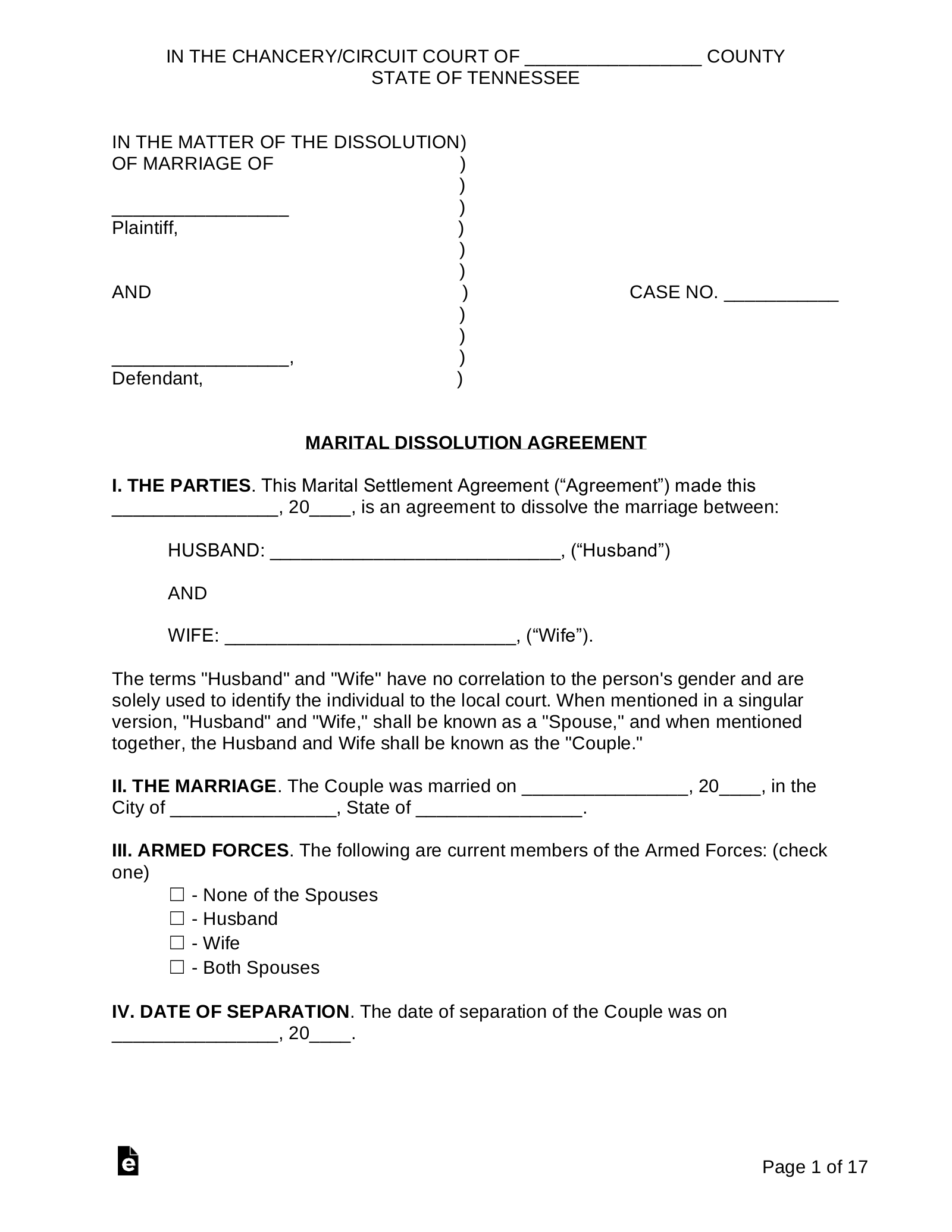
One way to proceed is to draft a comprehensive marital dissolution agreement (MDA). This document would lay out exactly how all assets and debts are divided, confirm there are no children of the marriage, and address any other relevant terms. Having an MDA in place often simplifies the court process since the judge can review and approve what the parties have already agreed upon. If they can't agree on everything, or if there are issues with his debts, then litigation may be necessary to have a judge decide those matters. Getting this agreement nailed down can help avoid a drawn-out court battle, especially with them being in different states.
Did I completely answer your question, and do you need clarification on anything? Please feel free to ask follow-up questions.
Thanks again for letting me assist you!
This sounds more complicated than just filing papers. Should we get a lawyer, or can they just list his/her assets and sign it? Is there a way for me to print this conversation?
She plans to collect the rest of her personal belongings and furniture that she had before the marriage. Is that OK to do before filing for divorce? Then she will have it in her possession.
I think one of her big concerns is that he may have accumulated some debt since she has been in TN and she doesn't want to be responsible for it.
TJ, Esq.
You're absolutely right that this is more complicated than just signing a few papers. While some divorces are truly simple, the situation with separate property, potential debts, and spouses living in different states adds layers that make going it alone pretty risky. They could try to list their assets and sign an agreement, but if that agreement isn't drafted correctly, or if all the necessary legal procedures aren't followed (like proper service to her husband in Kentucky), the court might not accept it, or it could lead to problems down the road. If the agreement isn't fair, a judge might not approve it, even if they both sign.
Regarding her collecting personal belongings and furniture that she had before the marriage, it's generally okay to gather separate property before filing for divorce, since that property belongs to her. However, if any of those items were used jointly during the marriage, or if there's any dispute over whether something is truly her separate property versus marital property, taking items could create issues or be seen as an attempt to hide assets, which is a big no-no. It's usually best if both parties agree on what's being taken, or if she has clear documentation proving it's hers. If there's any doubt, it's safer to wait until there's a formal agreement or court order.
Your sister's concern about her husband's potential debt is a very valid one. In Tennessee, debts accumulated during the marriage are typically considered "marital debt" and are subject to equitable division, just like assets. This means even if a debt is only in his name, if it was incurred during the marriage, she could potentially be on the hook for a portion of it. The court will consider who incurred the debt, the purpose of the debt, who benefited from it, and who is best able to repay it. If she doesn't want to be responsible for his debts, that absolutely needs to be clearly addressed in any settlement agreement, and perhaps through specific orders from the court. Without a formal agreement or court order, creditors can still pursue both parties if the debt is considered marital.
To print this conversation, you should be able to use the print function of your web browser. Look for a print icon or go to "File" and then "Print" in your browser's menu.
Did I completely answer your question, and do you need clarification on anything? Please feel free to ask follow-up questions.
I can't think of anything else now. Thanks so much for your help.
TJ, Esq.
You're very welcome! I'm happy I could help!
9
3
Answered 4 days ago
Disclaimer
By messaging AskaLawyer.com, you agree to our Terms and have read our Privacy Policy.
The information provided on AskaLawyer.com is for general informational purposes only and does not constitute legal advice. While we strive to ensure the accuracy and timeliness of the information presented, we make no guarantees regarding its completeness or applicability to your specific circumstances.
Use of this website does not create an attorney-client relationship between you and AskaLawyer.com or any of its attorneys. Communications through this website, including any responses from attorneys, are not privileged or confidential. For advice tailored to your individual situation, we recommend consulting a licensed attorney in your jurisdiction.
AskaLawyer.com disclaims any liability for actions taken or not taken based on the content of this site. We are not responsible for any third-party content that may be accessed through this website. Reliance on any information provided herein is solely at your own risk.