[AZ] [AZ] As a subcontractor, how can I secure payment from the contractor?
Getting paid on time in Arizona’s construction industry requires using the right tools and following strict legal procedures. One of the most important tools is the lien waiver. Arizona law requires specific statutory lien waiver forms (AZ Code § 33-1008), which act as receipts for payment and waive your right to file a mechanics’ lien for that amount.
There are four types—conditional and unconditional waivers for both progress and final payments. A conditional waiver is used when payment is expected but not yet received, preserving your lien rights until the money clears. An unconditional waiver should only be signed once payment is in hand, as it immediately waives your rights. These forms must include specific details and use the exact language required by Arizona law. Importantly, you cannot waive lien rights before work begins—any attempt to do so is void under state law.
Before filing a lien, Arizona requires that subcontractors send a Preliminary 20-Day Notice (AZ Code § 33-992.01(D)). This notice informs the property owner, general contractor, and lenders that you’re providing labor or materials and intend to protect your lien rights. It must be sent within 20 days of starting work or supplying materials. Failing to send it on time could mean losing your right to collect payment for earlier work.
A well-drafted subcontractor agreement is also essential. It should clearly outline payment terms, the scope of work, how change orders are handled, and how disputes will be resolved. While contracts can’t force you to give up lien rights in advance, they often include “pay-when-paid” or “paid-if-paid” clauses. In Arizona, “paid-if-paid” clauses can be enforceable if clearly worded, while “pay-when-paid” clauses usually just delay payment unless they specifically create a condition for payment.
Arizona’s Prompt Payment Act helps ensure timely payments. For private projects, owners have 14 days to approve pay requests and 7 days to pay. Contractors then have 7 more days to pay subcontractors. Public project timelines are slightly different, but the rules still apply. If deadlines aren’t met, interest of 1.5% per month can accrue, and subcontractors have the right to suspend work after giving proper notice (typically 3 days for private jobs).
If you’re not getting paid, start by reviewing your contract and documenting all communications. Send written notices via certified mail referencing your invoices. If both you and the contractor are licensed, consider filing a complaint with the Arizona Registrar of Contractors for claims over $750. A formal demand letter with a deadline and interest penalties can also be effective.
On private jobs, filing a mechanics’ lien may be the most powerful tool, but deadlines must be strictly followed. On public projects, payment claims are made against the contractor’s payment bond, since liens can’t be filed on public property. If all else fails, legal action may be necessary to recover the money owed, including interest and possibly attorney’s fees.
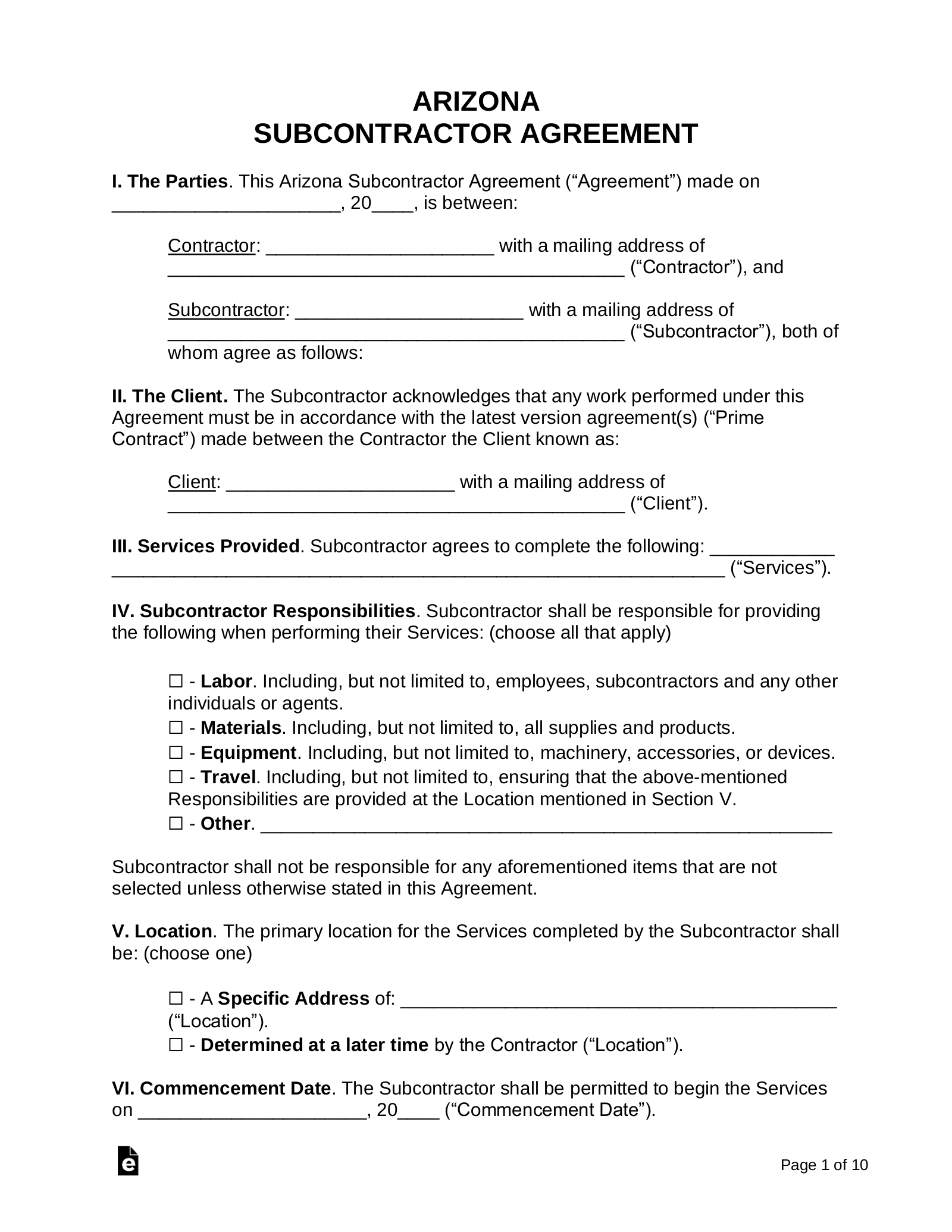
You can go on the eForms site to create such a subcontractor agreement for Arizona.
0
Arizona Subcontractor Agreement Template
Full Conversation
Hello, I need some assisting to see if there is some type of form or agreement that I can implement in my upcoming construction jobs. I need something that is binding and secures payment from contract to subcontractor.
I understand the importance of having a secure payment process in your construction jobs. Do you currently have any contracts or agreements in place with your subcontractors?
I am currently a subcontractor and work with contractors and yes I do have some agreements in place.
Are you looking for a specific type of form or agreement, such as a subcontractor agreement or a payment bond, to ensure payment security in your upcoming construction projects?
What is a payment bond?
Is there anything else the Lawyer should know before I connect you? Rest assured they’ll be able to help with payment security.
No.
Hello and thank you for reaching out! I’m Jon, a licensed attorney with over 13 years of experience, and I’m here to help.
I know legal matters can feel overwhelming, but you're in good hands. I’ll do my best to make things clear and provide you with the guidance you need. Let’s work together to find the right solution for your situation.
What state are you a subcontractor in?
Hello, Arizona.
Ok, and you need a form contract?
I am looking for some type of form that as a subcontractor will assure payment from the contractor. I am currently experiencing issues where some contractors are not wanting to pay.
Getting paid on time in Arizona’s construction industry requires using the right tools and following strict legal procedures. One of the most important tools is the lien waiver. Arizona law requires specific statutory lien waiver forms (AZ Code § 33-1008), which act as receipts for payment and waive your right to file a mechanics’ lien for that amount.
There are four types—conditional and unconditional waivers for both progress and final payments. A conditional waiver is used when payment is expected but not yet received, preserving your lien rights until the money clears. An unconditional waiver should only be signed once payment is in hand, as it immediately waives your rights. These forms must include specific details and use the exact language required by Arizona law. Importantly, you cannot waive lien rights before work begins—any attempt to do so is void under state law.
Before filing a lien, Arizona requires that subcontractors send a Preliminary 20-Day Notice (AZ Code § 33-992.01(D)). This notice informs the property owner, general contractor, and lenders that you’re providing labor or materials and intend to protect your lien rights. It must be sent within 20 days of starting work or supplying materials. Failing to send it on time could mean losing your right to collect payment for earlier work.
A well-drafted subcontractor agreement is also essential. It should clearly outline payment terms, the scope of work, how change orders are handled, and how disputes will be resolved. While contracts can’t force you to give up lien rights in advance, they often include “pay-when-paid” or “paid-if-paid” clauses. In Arizona, “paid-if-paid” clauses can be enforceable if clearly worded, while “pay-when-paid” clauses usually just delay payment unless they specifically create a condition for payment.
Arizona’s Prompt Payment Act helps ensure timely payments. For private projects, owners have 14 days to approve pay requests and 7 days to pay. Contractors then have 7 more days to pay subcontractors. Public project timelines are slightly different, but the rules still apply. If deadlines aren’t met, interest of 1.5% per month can accrue, and subcontractors have the right to suspend work after giving proper notice (typically 3 days for private jobs).
If you’re not getting paid, start by reviewing your contract and documenting all communications. Send written notices via certified mail referencing your invoices. If both you and the contractor are licensed, consider filing a complaint with the Arizona Registrar of Contractors for claims over $750. A formal demand letter with a deadline and interest penalties can also be effective.
On private jobs, filing a mechanics’ lien may be the most powerful tool, but deadlines must be strictly followed. On public projects, payment claims are made against the contractor’s payment bond, since liens can’t be filed on public property. If all else fails, legal action may be necessary to recover the money owed, including interest and possibly attorney’s fees.
You can go on the eForms site to create such a subcontractor agreement for Arizona.
Okay thank you!
18
7
Answered 3 weeks ago
26
10
Answered 3 weeks ago
Disclaimer
By messaging AskaLawyer.com, you agree to our Terms and have read our Privacy Policy.
The information provided on AskaLawyer.com is for general informational purposes only and does not constitute legal advice. While we strive to ensure the accuracy and timeliness of the information presented, we make no guarantees regarding its completeness or applicability to your specific circumstances.
Use of this website does not create an attorney-client relationship between you and AskaLawyer.com or any of its attorneys. Communications through this website, including any responses from attorneys, are not privileged or confidential. For advice tailored to your individual situation, we recommend consulting a licensed attorney in your jurisdiction.
AskaLawyer.com disclaims any liability for actions taken or not taken based on the content of this site. We are not responsible for any third-party content that may be accessed through this website. Reliance on any information provided herein is solely at your own risk.