Should I use a ladybird deed or a quitclaim deed?
1. Understanding the Purpose of a Lady Bird Deed
A standard Lady Bird Deed allows the grantor to:
- Keep a life estate in the property (meaning they can live there for life),
- Retain full control over the property during their lifetime,
- And automatically transfer the property to named beneficiaries (remaindermen) upon their death, avoiding probate.
The “unrestricted power to convey” is what makes it “enhanced.” It gives the grantor the ability to sell, mortgage, or gift the property while they’re alive, without the consent of the remaindermen.
2. Modifying the Deed to Remove the Power to Sell
If your friend wants to remove that power—meaning the grantor keeps the right to live in the property but cannot sell or transfer it during their lifetime—then what you are describing is more like a traditional life estate deed, not a Lady Bird Deed.
To make that change: Yes, you can delete the entire clause that says:
“The Grantor reserves a life estate for themselves during the Grantor’s lifetime coupled with an unrestricted power to convey during the Grantor’s lifetime…”
Replace it with something like:
“The Grantor reserves a life estate for themselves during the Grantor’s lifetime, without any retained power to sell, transfer, mortgage, or otherwise convey the property during their lifetime.”
This will restrict the grantor from transferring or mortgaging the property without the remaindermen’s consent. Be aware, though, that this limits flexibility and could complicate things later (for example, if they need to sell the home to move into assisted living).
3. How to Take a Name Off a Deed
If someone (such as a co-owner or prior owner) wants to remove their name from the deed, there are a couple of paths depending on the context:
- Voluntary removal: The person must sign and record a quitclaim deed or warranty deed transferring their interest to the remaining owner(s).
- Involuntary situations: If the person is deceased, incapacitated, or unwilling to sign, then additional legal steps may be needed (e.g., probate, court order, guardianship proceedings).
You’ll need to:
- Draft a new deed reflecting the updated ownership.
- Get it signed and notarized.
- File it with the county recorder or land records office.
If you’re making changes that affect ownership or powers under the deed, it’s best to make sure all involved parties consent to the change and that it’s done through a properly drafted and recorded instrument.
4. Next Steps for You
- Confirm the state law where the property is located allows for Lady Bird or life estate deeds.
- Use language reflecting the restricted life estate (no power to convey).
- Make sure the new deed is:
- Signed by the grantor (and grantee if needed),
- Notarized properly,
- Recorded in the appropriate county.
0
Ladybird Deed
Full Conversation
Hello. I am preparing a ladybird deed for a friend, but we need to change the grantor’s reserved rights so that he cannot sell the property at all. How can I change that on the deed?
Lexi, Chatbot
I understand that modifying a lady bird deed can be quite complex. Can you please share what specific changes you would like to make regarding the grantor’s reserved rights?
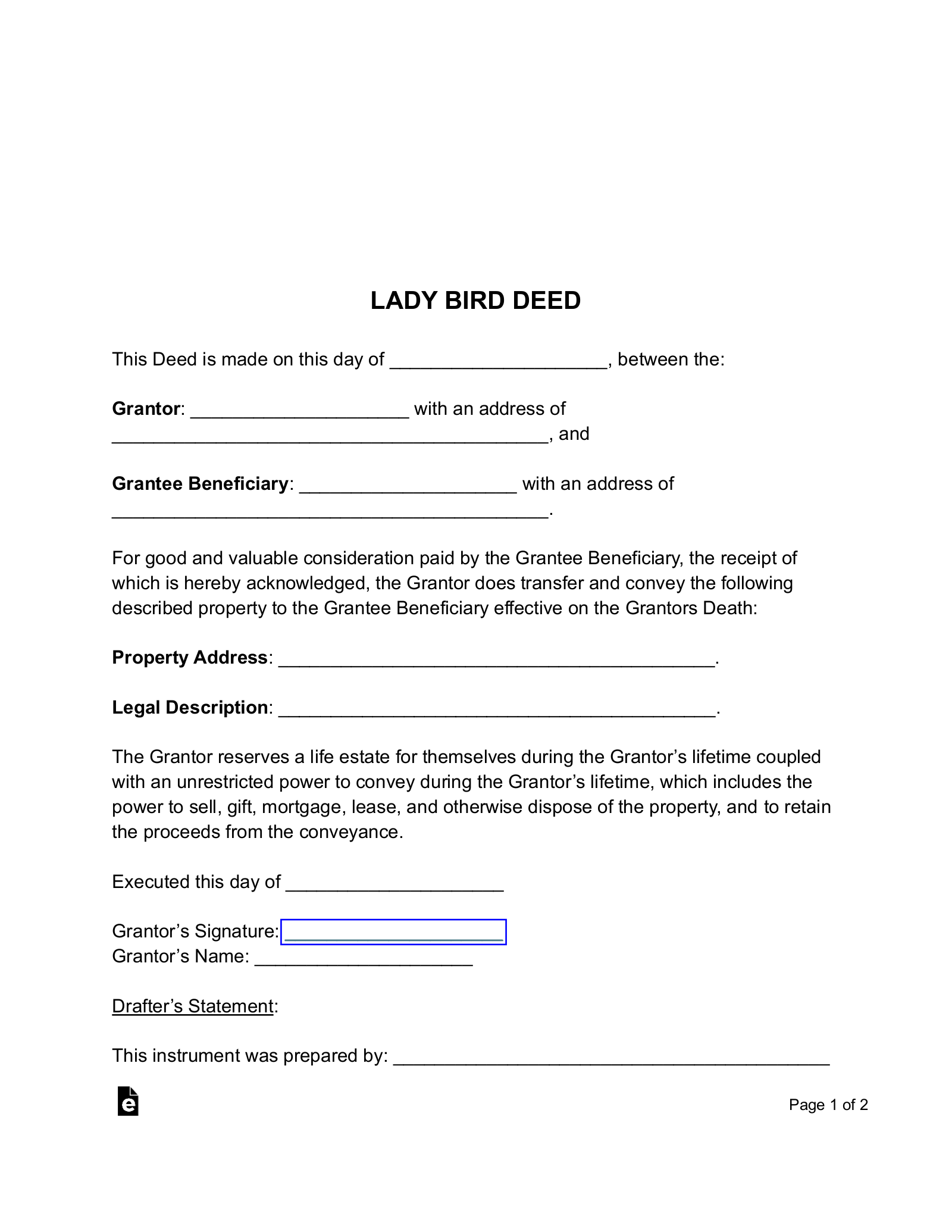
Need to change this part: The Grantor reserves a life estate for themselves during the Grantor’s lifetime coupled with an unrestricted power to convey during the Grantor’s lifetime, which includes the power to sell, gift, mortgage, lease and otherwise dispose of the property, and to retain the proceeds from the conveyance.
Lexi, Chatbot
Have you already drafted the lady bird deed, or are you starting from scratch?
Starting from scratch
Lexi, Chatbot
Is there anything else the Real Estate Lawyer should know before I connect you? Rest assured they’ll be able to help with your lady bird deed.
No
Brandon
Hi there and welcome to Just Answer. My name is Brandon and I’m an attorney. I’d be happy to help you out today. Please note that this discussion is for guidance only and does not constitute an attorney-client relationship. My answers and comments should not be considered legal advice.
Please also note that I am human, that I often need to research your answer to give you an accurate response, that I work with other customers and get up from time to time. So please be patient while waiting for a response. If more than 30 minutes have passed, please feel free to reach out.
Brandon
How can I assist?
I need to finish this deed but need to change certain things on the deed, the part where a grantor can reserve the right to sell the property
The Grantor reserves a life estate for themselves during the Grantor’s lifetime coupled with an unrestricted power to convey during the Grantor’s lifetime, which includes the power to sell, gift, mortgage, lease and otherwise dispose of the property, and to retain the proceeds from the conveyance.
Can this part be deleted from the deed itself?
How can someone take their name off a deed?
Brandon
1. Understanding the Purpose of a Lady Bird Deed
A standard Lady Bird Deed allows the grantor to:
- Keep a life estate in the property (meaning they can live there for life),
- Retain full control over the property during their lifetime,
- And automatically transfer the property to named beneficiaries (remaindermen) upon their death, avoiding probate.
The “unrestricted power to convey” is what makes it “enhanced.” It gives the grantor the ability to sell, mortgage, or gift the property while they’re alive, without the consent of the remaindermen.
2. Modifying the Deed to Remove the Power to Sell
If your friend wants to remove that power—meaning the grantor keeps the right to live in the property but cannot sell or transfer it during their lifetime—then what you are describing is more like a traditional life estate deed, not a Lady Bird Deed.
To make that change: Yes, you can delete the entire clause that says:
“The Grantor reserves a life estate for themselves during the Grantor’s lifetime coupled with an unrestricted power to convey during the Grantor’s lifetime…”
Replace it with something like:
“The Grantor reserves a life estate for themselves during the Grantor’s lifetime, without any retained power to sell, transfer, mortgage, or otherwise convey the property during their lifetime.”
This will restrict the grantor from transferring or mortgaging the property without the remaindermen’s consent. Be aware, though, that this limits flexibility and could complicate things later (for example, if they need to sell the home to move into assisted living).
3. How to Take a Name Off a Deed
If someone (such as a co-owner or prior owner) wants to remove their name from the deed, there are a couple of paths depending on the context:
- Voluntary removal: The person must sign and record a quitclaim deed or warranty deed transferring their interest to the remaining owner(s).
- Involuntary situations: If the person is deceased, incapacitated, or unwilling to sign, then additional legal steps may be needed (e.g., probate, court order, guardianship proceedings).
You’ll need to:
- Draft a new deed reflecting the updated ownership.
- Get it signed and notarized.
- File it with the county recorder or land records office.
If you’re making changes that affect ownership or powers under the deed, it’s best to make sure all involved parties consent to the change and that it’s done through a properly drafted and recorded instrument.
4. Next Steps for You
- Confirm the state law where the property is located allows for Lady Bird or life estate deeds.
- Use language reflecting the restricted life estate (no power to convey).
- Make sure the new deed is:
- Signed by the grantor (and grantee if needed),
- Notarized properly,
- Recorded in the appropriate county.
If the property has to be sold the new beneficiary can sell it?
Brandon
Yes, the beneficiary (also called the “remainderman”) can sell the property, but only after the grantor (life tenant) passes away.
Ok so this type of deed will not work. So a quitclaim deed will be better in this case correct?
If there are 2 people on a deed and only one is giving up the rights to the property can a quitclaim deed be filed just to change one of the grantors?
Brandon
When a Quitclaim Deed Does Make Sense
If there are two people on a deed—let’s say "John" and "Jane"—and "John" wants to give up all of his rights to the property so that "Jane" becomes the sole owner, then a quitclaim deed is exactly the tool to use.
In this case:
- "John" (grantor) would sign a quitclaim deed transferring his interest to "Jane" (grantee).
- Once the deed is signed, notarized, and recorded with the county recorder’s office, Mary will be the sole legal owner.
This type of deed doesn’t offer any warranties of title—it simply says, “Whatever interest I have, I now give to you.” That’s fine in a situation like this where the parties know and trust each other (family members, ex-spouses, etc.).
How to Prepare the Quitclaim Deed
Here’s what you’ll need:
- Names and marital status of both parties ("John" and "Jane", in our example).
- Property description—the legal description from the last recorded deed, not just the address.
- Statement of transfer—such as:
“John Smith, an individual, does hereby quitclaim unto Jane Smith, an individual, all of his right, title, and interest in and to the following described real property…” - Signature of the grantor (the person giving up rights)—must be notarized.
- Notary acknowledgment.
- Recording—take it to the county clerk or recorder’s office where the property is located and file it.
Important Caution
A quitclaim deed only changes ownership. It does not affect:
- Mortgages: If both parties are on a mortgage, the person giving up ownership is still financially responsible unless they refinance.
- HOA agreements, property taxes, or utility accounts. Those may need to be updated separately.
So if the person being removed is also on the mortgage, this could create future risk—something to be mindful of.
On the current deed there are 2 people "John" and "Jane", now "John" is giving his right to his granddaughter so does the new deed need to include "Jane" as well?
The only person on the mortgage is "Jane"
So when he transfers his part to his granddaughter "Ellie Sanchez", Mary’s name will continue on the deed?
She is retaining her part and she is the only one on the mortgage.
Brandon
Here’s the correct way to handle this:
Yes, "Jane's" name should still appear on the new deed, but only John will be listed as the grantor, and "Ellie Sanchez" will be listed as the grantee alongside "Jane".
You’re not removing "Jane" or changing her ownership, you’re just updating the record to reflect that "John's" portion now belongs to "Ellie". So you’re replacing "John's" name with "Ellies" on the deed. "Jane's" interest stays the same.
What the Deed Should Say (Simplified)
Here’s a basic example of how the quitclaim deed language should look:
“John Smith, a grantor, does hereby quitclaim unto Ellie, a grantee, all of his right, title, and interest in and to the following described property...”
The property being currently held by John Smith and Jane Smith as joint tenants (or tenants in common, depending on how the original deed is written).
After recording, the ownership of said property shall be vested in "Jane Smith" and "Ellie Sanchez".
But here’s a key legal note:
You need to make sure of how "John" and "Jane" currently hold title:
-
If they are “joint tenants with rights of survivorship,” then when one of them dies, the other would normally inherit the entire property automatically.
-
If "John" deeds his interest to "Ellie", it breaks the joint tenancy and converts it to tenants in common, meaning "Ellie" and "Jane" each own a defined share (likely 50/50 unless otherwise stated).
-
If they are “tenants in common,” then each owns a separate share already, and "John" is free to transfer his share to "Ellie" without affecting "Jane's" ownership.
So—check the original deed to see whether it says “joint tenants,” “tenants in common,” or is silent on the matter. That will determine whether the joint tenancy is severed by the transfer.
Thank you
Brandon
You’re very welcome.
15
6
Answered 4 days ago
Disclaimer
By messaging AskaLawyer.com, you agree to our Terms and have read our Privacy Policy.
The information provided on AskaLawyer.com is for general informational purposes only and does not constitute legal advice. While we strive to ensure the accuracy and timeliness of the information presented, we make no guarantees regarding its completeness or applicability to your specific circumstances.
Use of this website does not create an attorney-client relationship between you and AskaLawyer.com or any of its attorneys. Communications through this website, including any responses from attorneys, are not privileged or confidential. For advice tailored to your individual situation, we recommend consulting a licensed attorney in your jurisdiction.
AskaLawyer.com disclaims any liability for actions taken or not taken based on the content of this site. We are not responsible for any third-party content that may be accessed through this website. Reliance on any information provided herein is solely at your own risk.