[NY] How do I designate an account for non-probate expenses?

Hi, I'm in New York. All my financial accounts will go directly to named beneficiaries, which are already set up. There is one brokerage account I’d like designated to have any taxes, debts, and estate expenses paid from. Can I do that?

21

7

TJ, Esq.
TJ, Esq.

17,778 satisfied customers

View context
Solved

An account with a named beneficiary generally passes outside the will (non-probate) — it goes directly to the beneficiary. For an executor to use those funds to pay estate expenses, you generally need specific language in your will directing that use. Without it, the executor may not be able to require the beneficiary to use those funds for estate debts, even if the beneficiary is cooperative.

A common approach is to include explicit will language that directs the executor to use the funds from that specific account to pay estate taxes, debts, and administrative expenses, and then direct that any remaining balance pass to the named beneficiary.

If you don’t direct otherwise, estate expenses are paid from probate assets first — i.e., assets that are part of your estate under the will (bank accounts without beneficiary designations, property not passing by right of survivorship, etc.). New York has an order of abatement for which assets are used first (NY Est. Power and Trusts Law § 13-1.3).

Non-probate assets (like a beneficiary-designated brokerage account) typically aren’t available to pay estate debts unless the will specifically creates a legal charge on them or you otherwise direct their use.

0

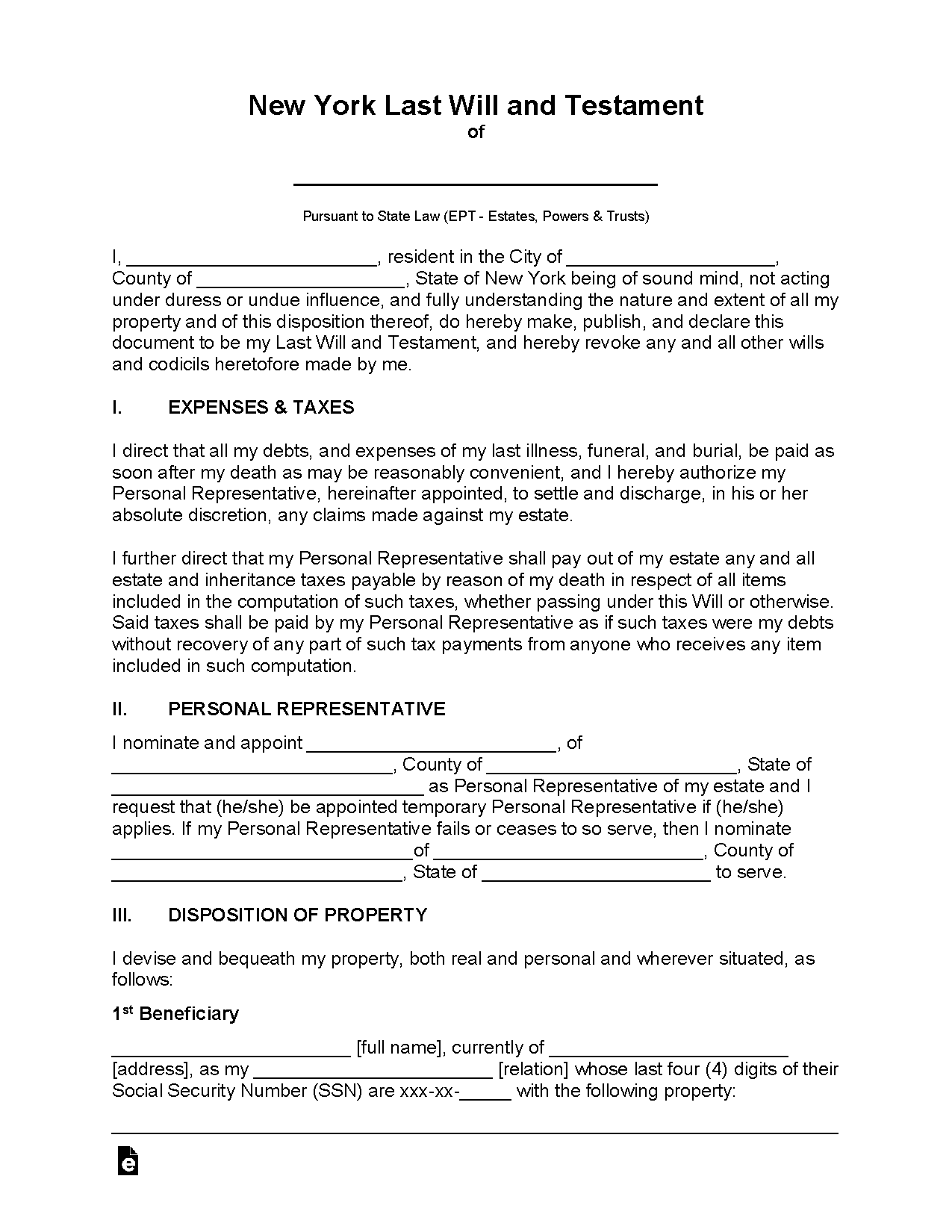
New York Last Will and Testament

Full Conversation


Hi, I'm in New York. All my financial accounts will go directly to named beneficiaries, which are already set up. There is one brokerage account I’d like designated to have any taxes, debts, and estate expenses paid from. Can I do that?

Lexi

Lexi, Chatbot

I understand. Have you consulted an estate lawyer in New York about this?

No.

Lexi

Lexi, Chatbot

Are you looking to set up a specific provision in your will that designates the particular brokerage account for these expenses?

Yes, that would be great!

Lexi

Lexi, Chatbot

Is there anything else the lawyer should know before I connect you?

No, that’s it.

TJ, Esq.

TJ, Esq.

Hello! I’m TJ, an attorney. Thanks for the opportunity to assist you. You can generally designate a specific brokerage account in your will to cover taxes, debts, and estate expenses in New York. That’s common and helps streamline administration. Do you anticipate significant debts or taxes that would require a large portion of this account? Any specific instructions for the distribution of remaining funds after expenses are paid?

I don’t expect significant debts or expenses. There should be no estate tax. I paid just under $10,000 in combined state and federal taxes last year — I don’t think it should be more than that. The account I’d like used currently has a balance around $1,000,000, so it’s a small percentage.

TJ, Esq.

TJ, Esq.

Helpful. Have you named a specific executor in your will, and are they aware of your wishes regarding this account?

Yes — I’ve named an executor, and he is also the beneficiary on that account. He understands and has no objections. I also don’t want that account to go through probate. If I don’t put any of this in the will, but just leave beneficiaries as they are, where does the money for taxes, debts, etc., come from?

TJ, Esq.

TJ, Esq.

An account with a named beneficiary generally passes outside the will (non-probate) — it goes directly to the beneficiary. For an executor to use those funds to pay estate expenses, you generally need specific language in your will directing that use. Without it, the executor may not be able to require the beneficiary to use those funds for estate debts, even if the beneficiary is cooperative.

A common approach is to include explicit will language that directs the executor to use the funds from that specific account to pay estate taxes, debts, and administrative expenses, and then direct that any remaining balance pass to the named beneficiary.

If you don’t direct otherwise, estate expenses are paid from probate assets first — i.e., assets that are part of your estate under the will (bank accounts without beneficiary designations, property not passing by right of survivorship, etc.). New York has an order of abatement for which assets are used first (NY Est. Power and Trusts Law § 13-1.3).

Non-probate assets (like a beneficiary-designated brokerage account) typically aren’t available to pay estate debts unless the will specifically creates a legal charge on them or you otherwise direct their use.

I have a tiny business account (I’m mostly retired), a personal account I use to pay bills (rarely more than $10,000 in it), and a used car (no other valuable assets). Rent will need to be paid for a couple months; I always have a $1,500–$2,000 AMEX bill, etc.

TJ, Esq.

TJ, Esq.

Given those modest probate assets, those would be the primary sources to pay debts and expenses. If they’re insufficient, creditors might not be fully paid and the executor may need to sell assets (e.g., your car). If you want the beneficiary’s brokerage account to be a backup source so the estate is fully covered, the will should say so in clear language.

I’m fine with my car being sold and small probate accounts emptied to pay things. I’d like anything not covered by those accounts to be paid from the brokerage account because it seems right. My executor is my long-time boyfriend and also the beneficiary on that account. The account funds are money he gave me. He’d like to see me leave with a clean financial slate. So theoretically, I could leave his account as non-probate and just personally ask him to pay those things — he’ll do it. I want to be sure my nieces and nephew (beneficiaries of my other accounts that I inherited from my mom) will not have money taken from them.

TJ, Esq.

TJ, Esq.

A personal request is valuable but not legally binding on the executor/beneficiary. If you want legal certainty (so the account is used for estate expenses before distributions to other beneficiaries), include explicit will language imposing a charge on that account for estate debts and expenses, limited to the amount needed. That gives legal direction and protects your nieces and nephew from having their inheritances reduced, since payments would come first from the designated brokerage account (as you direct).

Ok — so if I put in the will that those expenses (beyond what’s in the probate accounts + car) should be paid from the account where he’s the beneficiary, does that mean the whole account goes through probate? Or just the amount necessary? I want it both ways!

TJ, Esq.

TJ, Esq.

You can draft the clause so only the amount necessary is used — not the entire account. Precise wording is crucial: direct that the account be used up to the needed amount for taxes, debts, and expenses, and that any remaining balance pass to the named beneficiary outside probate.

We’re getting much closer! Can I use the wording in the “specific wording” paragraph you wrote, filling in the beneficiary’s name, account number, etc., in my will? How about this draft I made:

R.H., named beneficiary on Account #XYZ, is directed to use the funds from Account #XYZ up to the amount needed to satisfy estate debts, taxes, and expenses that cannot be covered by my other probate assets. Any balance remaining in that account, after these obligations are met, will pass directly to R.H., the named beneficiary, as originally designated.

TJ, Esq.

TJ, Esq.

Your draft is pretty clear and expresses your intent well. For extra precision, I’d recommend identifying the financial institution and account type as well (for example: “Brokerage account held at [Institution Name], account no. [XYZ]”) to eliminate any ambiguity about which account you mean.

If you want, I can tighten the wording further into a clean, legally precise clause you can drop into your will.

Thanks. I'm good.

TJ, Esq.

TJ, Esq.

17,778 satisfied customers

TJ, Esq.
Welcome! Have a similar question?

5 lawyers online now

Jessica B
Jessica B

Attorney

4.75 (29,480)

[OH] How do I file a small estate affidavit for transferring stock?

12

3

Answered 1 week ago

Disclaimer


By messaging AskaLawyer.com, you agree to our Terms and have read our Privacy Policy.

The information provided on AskaLawyer.com is for general informational purposes only and does not constitute legal advice. While we strive to ensure the accuracy and timeliness of the information presented, we make no guarantees regarding its completeness or applicability to your specific circumstances.

Use of this website does not create an attorney-client relationship between you and AskaLawyer.com or any of its attorneys. Communications through this website, including any responses from attorneys, are not privileged or confidential. For advice tailored to your individual situation, we recommend consulting a licensed attorney in your jurisdiction.

AskaLawyer.com disclaims any liability for actions taken or not taken based on the content of this site. We are not responsible for any third-party content that may be accessed through this website. Reliance on any information provided herein is solely at your own risk.

Ask a Lawyer Logo
Ask a Lawyer Logo
Intake Questions
Step of 3
Loading...
Loading...

How do you like to pay?

By proceeding with payment, you agree to our Terms and Privacy Policy. You authorize us to charge $ today and $ thereafter until canceled. You may cancel anytime in the My Account section to stop future charges.

Total Due:

After purchasing, your chat will begin with an attorney.

By proceeding with payment, you agree to our Terms and Privacy Policy. You authorize us to charge $ today and $ thereafter until canceled. You may cancel anytime in the My Account section to stop future charges.

Total Due:

After purchasing, your chat will begin with an attorney.

It looks like you already have an account with Ask a Lawyer.

We have sent you a magic link to . Click the link in your email to sign in and continue your chat.

spin

Step of 6 •

You'll receive an email at as soon as the lawyer joins the conversation 🙏🏻😊

Over 90% of lawyers connect within 5 minutes. If you're not online at that moment, don't worry — the lawyer will reply to your message while you're away.

You're also welcome to stay in the chat while waiting to be connected 💬✨

Waiting for lawyer