[TX] My father owns property in Texas and his wife passed away. What do I do if the only heir doesn’t want the property?
If the deed doesn't specifically say "joint tenants with right of survivorship," then the wife’s half interest would have gone to her heirs. If her heir (daughter) doesn’t want the property, you can fill out the Affidavit of Heirship for your father, which you've already done.
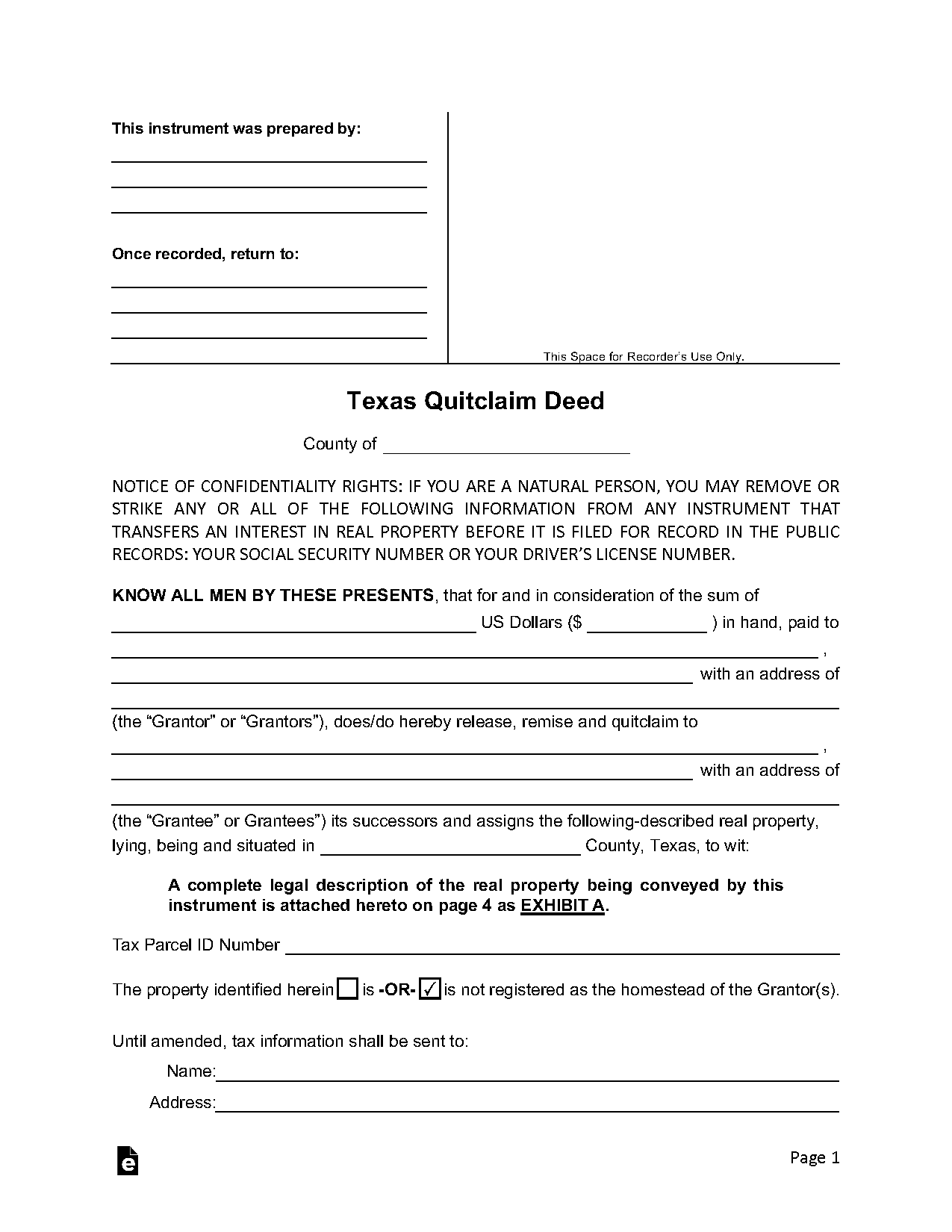
The daughter would then sign a quitclaim deed from herself (as Grantor) to your father (as Grantee). Then your father can record that quitclaim deed with the county recorder to become sole owner.
0
Texas Quit Claim Deed Form
Full Conversation
I need a question regarding a deed in Texas. My father owns property in Texas and his wife passed away. The only heir does not want the property, so I’m filling out the deed. I had to file an Affidavit of Heirship because the homestead expired and his wife passed. Now that is done—I just need help with the deed.
Barrister
Hello and welcome to the site! My name is Barrister and I’m a licensed attorney here to help. If you can post your legal question and some details, I’ll assist.
Are both your father and his wife on the deed? And were they listed as "joint tenants with right of survivorship"?
Yes, they are listed together as married. The property is in Bandera County, Texas.
Barrister
If the deed doesn't specifically say "joint tenants with right of survivorship," then the wife’s half interest would have gone to her heirs. If her heir (daughter) doesn’t want the property, you can fill out the Affidavit of Heirship for your father, which you've already done.
The daughter would then sign a quitclaim deed from herself (as Grantor) to your father (as Grantee). Then your father can record that quitclaim deed with the county recorder to become sole owner.
So use a quitclaim deed—not a general deed?
Barrister
Correct. Either will work legally, but a quitclaim deed is simpler and easier to execute.
So who should prepare the deed—me or my father?
Barrister
It doesn’t matter who prepares it. The Grantor is the daughter, the Grantee is your father.
What do I write for “consideration”?
Barrister
Typically, for a gift, write “One Dollar” and then list $1.00 in the amount. It’s symbolic to show value was exchanged.
Understood. On the form where it says “Grantee, by its acceptance of this deed, assumes payment of all standby charges, ad valorem taxes, and assessments for the year”—do I just put the year?
Yes, just insert the current year.
Thanks. There’s also a section:
“WITNESS: That the Grantor(s), in consideration of the sum of $____ and other good and valuable...”
So I write out “One Dollar” and then “$1.00”?
Barrister
Correct.
There is no Grantor 2 since she is the only heir?
Barrister
Correct. Leave Grantor 2 blank.
She’s married—how do I complete the marital status clause? It reads:
Grantor is a married person exercising management and control of Grantor’s separate property not claimed as homestead.
Would that apply?
Barrister
Yes. Inheritance is separate property, so that clause is appropriate.
Got it. Does only the Grantor sign in front of a notary?
Barrister
Yes, only the Grantor (the daughter) signs. The deed can be notarized anywhere—not just in Texas.
She will sign in Massachusetts. The notary section says “Notary Public – State of Texas.” Should I change that?
Barrister
Yes. Update it to reflect the state where she is notarizing it, in this case, Massachusetts.
Perfect. I’ll revise that. Thank you so much!
Disclaimer
By messaging AskaLawyer.com, you agree to our Terms and have read our Privacy Policy.
The information provided on AskaLawyer.com is for general informational purposes only and does not constitute legal advice. While we strive to ensure the accuracy and timeliness of the information presented, we make no guarantees regarding its completeness or applicability to your specific circumstances.
Use of this website does not create an attorney-client relationship between you and AskaLawyer.com or any of its attorneys. Communications through this website, including any responses from attorneys, are not privileged or confidential. For advice tailored to your individual situation, we recommend consulting a licensed attorney in your jurisdiction.
AskaLawyer.com disclaims any liability for actions taken or not taken based on the content of this site. We are not responsible for any third-party content that may be accessed through this website. Reliance on any information provided herein is solely at your own risk.