[SC] [SC] My sister fell ill. Is notary required for POA if she is unable to leave the hospital?
In South Carolina, a Power of Attorney document must be signed by the principal and acknowledged before a notary public to be legally valid. (§ 62-8-105)
Witnesses do not replace the notary requirement. South Carolina follows the Uniform Power of Attorney Act, which requires notarization. Without a notary, the POA may not be accepted by banks, title companies, or other institutions.
If your sister is still conscious and mentally capable, you may be able to arrange for a mobile notary to come to the hospital. Many hospitals either have notaries on staff or work regularly with mobile notaries. Depending on the hospital’s policies, remote/online notarization may also be possible if allowed by South Carolina law.
If a notary cannot be obtained and your sister becomes unable to sign, you may need to pursue guardianship or conservatorship through probate court. This allows someone (likely you) to be appointed to manage finances and make decisions. In urgent cases, you can request an emergency hearing. Speaking with an estate planning or elder law attorney in South Carolina as soon as possible is recommended.
0
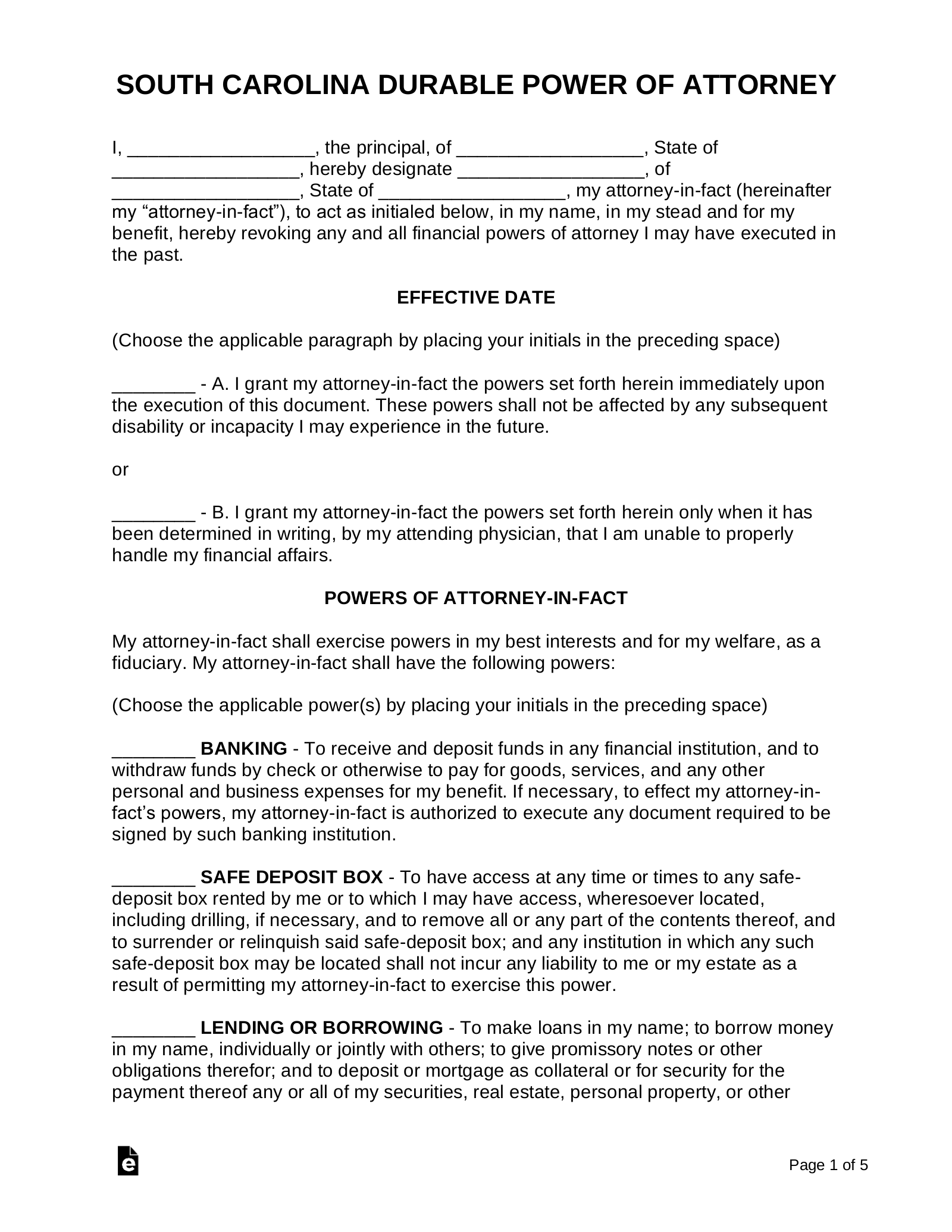
South Carolina Durable (Financial) Power of Attorney Form
Full Conversation
My sister has taken suddenly ill and is in the hospital and may not get better. She has no husband or children and I (her brother) am her only living relative. She has substantial assets including three homes and a sizable savings and investments. She is still conscious, but is unlikely to be able to leave the hospital to have a notary sign the document that I have created for her with eForms giving me POA. Is having a notary necessary, or will witnesses do?
Lexi, Chatbot
I’m sorry to hear about your sister’s situation. Have you consulted with a legal professional regarding the Power of Attorney document you’ve created for her?
No. This has all been sudden.
Lexi, Chatbot
Are you aware of the specific requirements in your state regarding the signing and witnessing of Power of Attorney documents?
Just what eForms tells me. What is the rule in South Carolina?
Lexi, Chatbot
Is there anything else the Lawyer should know before I connect you?
No.
Dan
Hello and welcome. My name is Daniel, and I’ve been a licensed lawyer for more than 21 years. I’m truly sorry you’re going through this and I'm here to help. You want to confirm if POA can just be signed and is sufficient that way?
Yes.
Dan
In South Carolina, a Power of Attorney document must be signed by the principal and acknowledged before a notary public to be legally valid. (§ 62-8-105)
Witnesses do not replace the notary requirement. South Carolina follows the Uniform Power of Attorney Act, which requires notarization. Without a notary, the POA may not be accepted by banks, title companies, or other institutions.
If your sister is still conscious and mentally capable, you may be able to arrange for a mobile notary to come to the hospital. Many hospitals either have notaries on staff or work regularly with mobile notaries. Depending on the hospital’s policies, remote/online notarization may also be possible if allowed by South Carolina law.
If a notary cannot be obtained and your sister becomes unable to sign, you may need to pursue guardianship or conservatorship through probate court. This allows someone (likely you) to be appointed to manage finances and make decisions. In urgent cases, you can request an emergency hearing. Speaking with an estate planning or elder law attorney in South Carolina as soon as possible is recommended.
Dan
Does all of that make sense to you?
Yes.
Disclaimer
By messaging AskaLawyer.com, you agree to our Terms and have read our Privacy Policy.
The information provided on AskaLawyer.com is for general informational purposes only and does not constitute legal advice. While we strive to ensure the accuracy and timeliness of the information presented, we make no guarantees regarding its completeness or applicability to your specific circumstances.
Use of this website does not create an attorney-client relationship between you and AskaLawyer.com or any of its attorneys. Communications through this website, including any responses from attorneys, are not privileged or confidential. For advice tailored to your individual situation, we recommend consulting a licensed attorney in your jurisdiction.
AskaLawyer.com disclaims any liability for actions taken or not taken based on the content of this site. We are not responsible for any third-party content that may be accessed through this website. Reliance on any information provided herein is solely at your own risk.