[VA] My mother is assigning POA to me and my brother as the successor agent. Who needs to sign in front of the notary?
In Virginia, you're correct that only the principal (your mother) needs to sign the Power of Attorney in front of a notary to make it valid, along with you as the original agent if you want your signature acknowledged. (VA Code § 64.2-1603)
Here’s a clearer breakdown:
Principal’s Signature
- Your mother must sign the POA in front of a notary. This makes the POA legally valid.
Original Agent’s Acknowledgment (You)
- Your signature is not legally required for the POA to be valid.
- However, many banks require an “agent certification,” which you can sign now or later.
Successor Agent (Your Brother)
- Your brother does not need to sign anything at the time the POA is created.
- He signs only when he actually needs to assume authority.
0
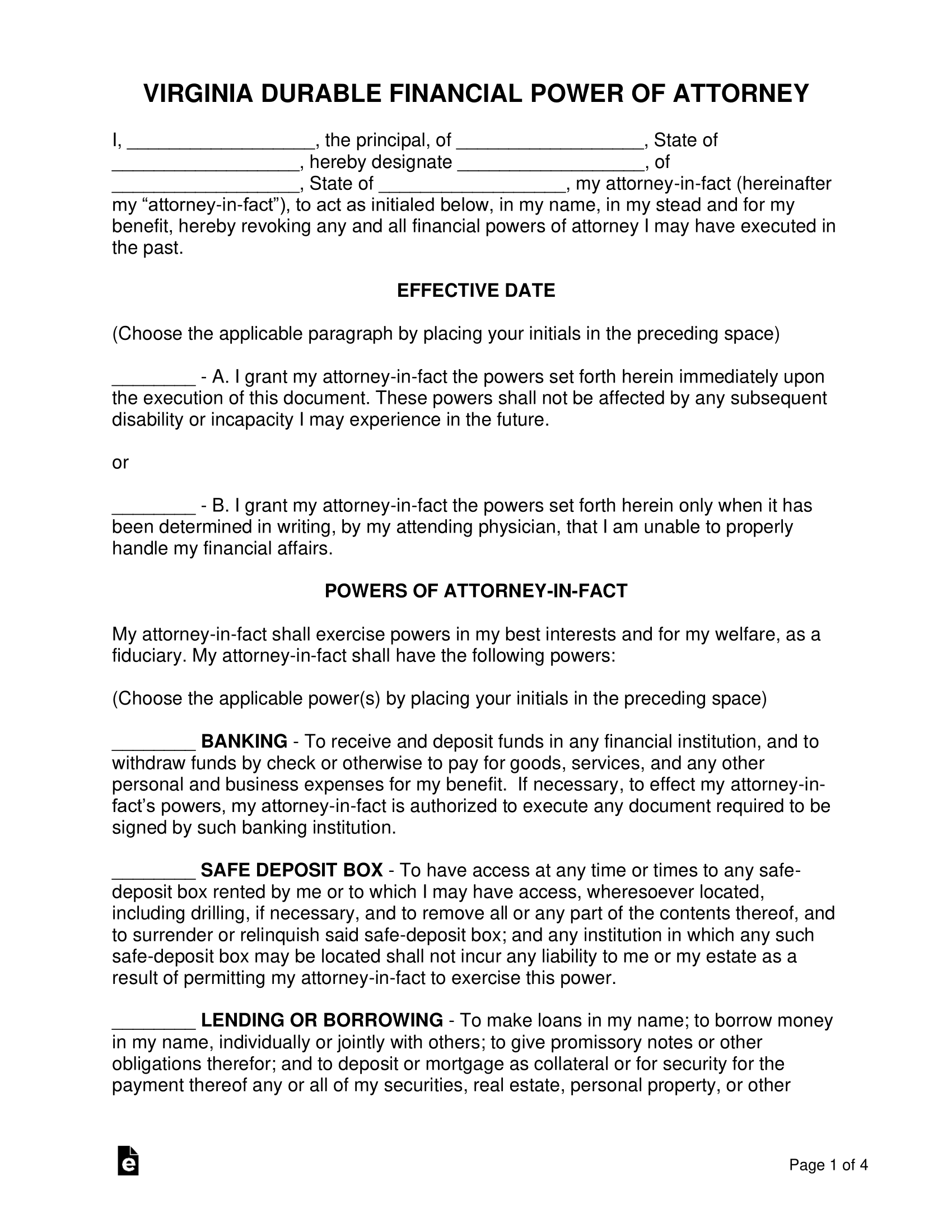
Virginia Durable Financial Power of Attorney Form
Full Conversation
This power of attorney agreement assigns POA to me, and then to my brother if I am no longer able to serve as Agent. In other words he would be my successor. My question is this: Who needs to sign in front of a notary to create the POA? I think just my mother and myself. My brother would sign in the case when he needs to assume POA. Is that correct?
Lexi, Chatbot
I understand you have questions about the power of attorney agreement. Who is currently designated as the Agent in the document?
I am.
Lexi, Chatbot
Have you already consulted with a legal professional regarding the specifics of this power of attorney agreement?
Yes.
Lexi, Chatbot
Is there anything else the Estate Lawyer should know before I connect you? Rest assured they’ll be able to help with your power of attorney agreement.
Nothing else. I already exercise POA for my mother under a current agreement similar to this. My mother just wants to add my brother as a successor if I’m incapacitated.
Andres Sanchez
Hello, my name is Andres Sanchez, and I am an attorney with 20 years of experience. What state are you in?
Virginia.
Andres Sanchez
In Virginia, you're correct that only the principal (your mother) needs to sign the Power of Attorney in front of a notary to make it valid, along with you as the original agent if you want your signature acknowledged. (VA Code § 64.2-1603)
Here’s a clearer breakdown:
Principal’s Signature
- Your mother must sign the POA in front of a notary. This makes the POA legally valid.
Original Agent’s Acknowledgment (You)
- Your signature is not legally required for the POA to be valid.
- However, many banks require an “agent certification,” which you can sign now or later.
Successor Agent (Your Brother)
- Your brother does not need to sign anything at the time the POA is created.
- He signs only when he actually needs to assume authority.
Your instructions are clear, but the form has a paragraph for me and my brother on the same page with one place for notarization. Would it be better to have a separate Agent Notification for my brother to sign when necessary?
Andres Sanchez
That’s an excellent observation — and you’re right to pause here.
If the form has one notary block for both you and your brother, that implies both signatures are being notarized at the same time. That can create confusion, because:
- Your brother has no authority yet, and
- Signing now can make it look like he is accepting authority immediately.
- So yes — it’s better to have him sign later, using a separate Agent Certification.
Best practice:
- Your mother signs + notarizes the POA
- You may sign an agent acceptance, but it’s optional
- Your brother signs only when he steps in, using a one-page “Successor Agent Acceptance” form
This avoids confusion and keeps institutions from thinking both agents are active at once.
Thank you! That helps a lot. I understand how to complete this now.
Disclaimer
By messaging AskaLawyer.com, you agree to our Terms and have read our Privacy Policy.
The information provided on AskaLawyer.com is for general informational purposes only and does not constitute legal advice. While we strive to ensure the accuracy and timeliness of the information presented, we make no guarantees regarding its completeness or applicability to your specific circumstances.
Use of this website does not create an attorney-client relationship between you and AskaLawyer.com or any of its attorneys. Communications through this website, including any responses from attorneys, are not privileged or confidential. For advice tailored to your individual situation, we recommend consulting a licensed attorney in your jurisdiction.
AskaLawyer.com disclaims any liability for actions taken or not taken based on the content of this site. We are not responsible for any third-party content that may be accessed through this website. Reliance on any information provided herein is solely at your own risk.