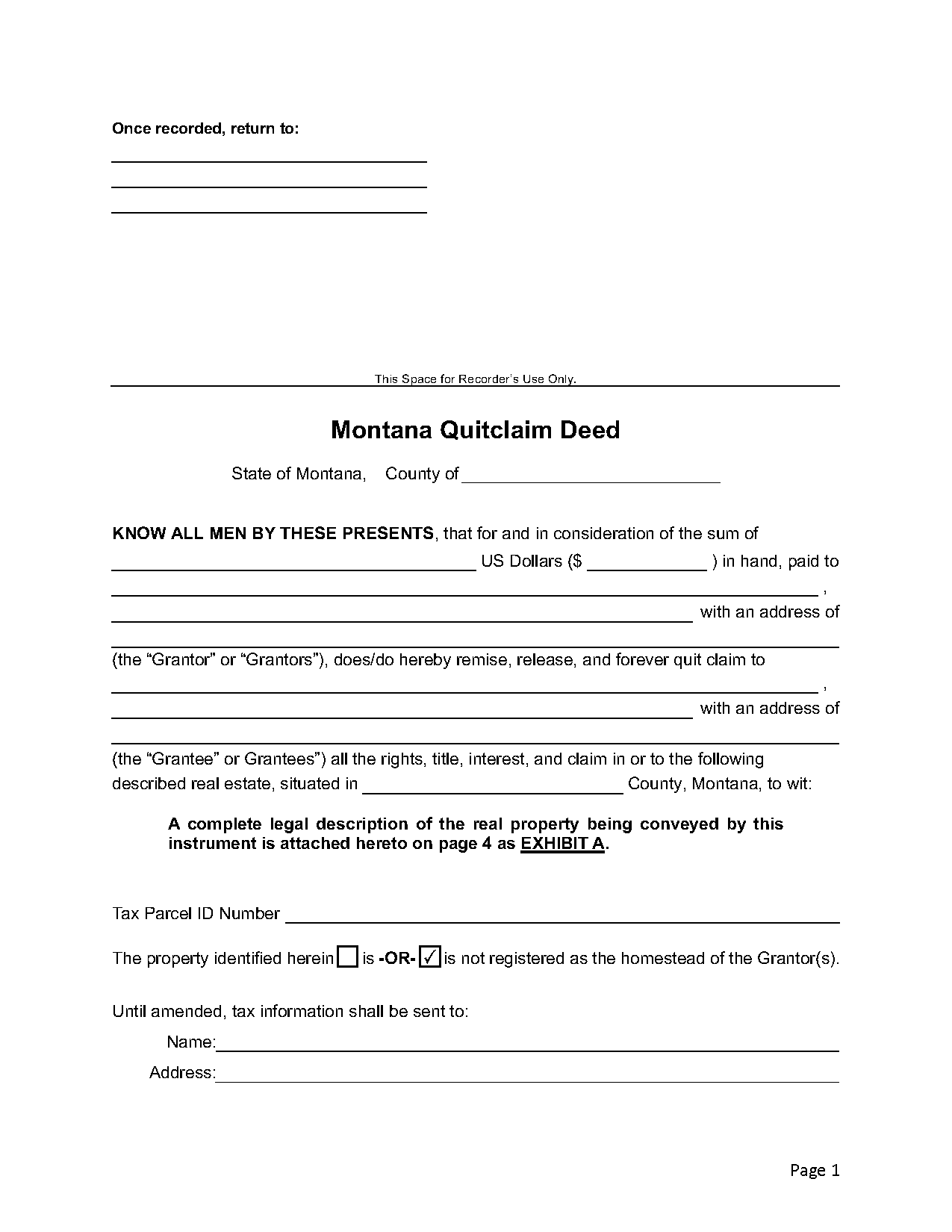
[MT] [MT] If I’m removing my ex-spouse from a real estate title, do I need to disclose the amount I paid them on the quit claim deed?
Whether to include the amount you paid to your ex-spouse depends on why you’re including it:
- If you're referencing it to explain consideration (what was exchanged for the transfer), then yes, you can note the amount as part of the historical context. It may be worded as
- “For valuable consideration, the receipt of which is hereby acknowledged, including but not limited to the sum of $97,000 previously paid on [insert date], Grantor hereby conveys all right, title, and interest to Grantee...
- However, while Montana requires the consideration paid to be declared on a realty transfer certificate, the dollar amount usually does not have to be listed on the quit claim deed itself (MCA § 15-7-305(1)). In fact, it's common to see vague language like “for $10 and other valuable consideration.” This protects privacy and can help avoid unnecessary questions down the line (such as triggering a reassessment or taxes).
So, unless there's a strategic or legal reason to disclose the $97K on the face of the deed (such as supporting a legal obligation or reflecting a buyout on record), it might be best to omit the dollar amount from the deed itself and instead keep a copy of the buyout agreement or receipt separately in your records.
0
Montana Quit Claim Deed
Full Conversation
Hello, I am trying to remove my ex-spouse from the real estate we purchased together. I paid him 97k back in 2022 for the property but had 36 months to remove him from the title. Would I put the 97k on the document, even though I paid it 3 years ago?
Lexi, Chatbot
I understand this situation can be frustrating. Have you consulted with a lawyer regarding the process of removing your ex-spouse from the real estate title?
Yes.
Lexi, Chatbot
Have you kept any documentation or proof of the $97k payment you made to your ex-spouse back in 2022?
Yes.
Lexi, Chatbot
Is there anything else the Lawyer should know before I connect you? Rest assured they'll be able to help with removing your ex-spouse from the real estate title.
No.
Brandon
Hi there and welcome to AskaLawyer. My name is Brandon and I'm an attorney. I'd be happy to help you out today.
Brandon
Where are you located?
I am located in California; however, the property in question is in Montana.
Brandon
Thank you for that clarification. Here's how you should approach this:
First, take a look at any written agreement between you and your ex-spouse from 2022 when the $97K changed hands. Was there a formal contract, a buyout agreement, or even just a notarized letter stating:
- That this payment was for their share of the property?
- That you would have 36 months to remove them from the deed?
If this was only a verbal agreement or informal message (texts, emails, etc.), it doesn’t mean you’re stuck—but the process might involve some additional steps or proof.
Brandon
Next, determine the type of deed transfer you'll use. In Montana, property transfers between co-owners after a buyout are often done using a Quit Claim Deed or a Warranty Deed. Here's a simple way to decide what makes sense:
- Quit Claim Deed: Quick and straightforward. Your ex-spouse gives up any claim to the property. This does not involve warranties of title.
- Warranty Deed: Provides assurances that the title is clear. This is more protective for you, but also more formal.
Because you already paid him and you’re just fulfilling a condition from an earlier agreement, a Quit Claim Deed might be enough—but it depends on whether the title company or lender (if there’s a mortgage involved) requires anything more formal.
Brandon
Whether to include the amount you paid to your ex-spouse depends on why you’re including it:
- If you're referencing it to explain consideration (what was exchanged for the transfer), then yes, you can note the amount as part of the historical context. It may be worded as
- “For valuable consideration, the receipt of which is hereby acknowledged, including but not limited to the sum of $97,000 previously paid on [insert date], Grantor hereby conveys all right, title, and interest to Grantee...
- However, while Montana requires the consideration paid to be declared on a realty transfer certificate, the dollar amount usually does not have to be listed on the quit claim deed itself (MCA § 15-7-305(1)). In fact, it's common to see vague language like “for $10 and other valuable consideration.” This protects privacy and can help avoid unnecessary questions down the line (such as triggering a reassessment or taxes).
So, unless there's a strategic or legal reason to disclose the $97K on the face of the deed (such as supporting a legal obligation or reflecting a buyout on record), it might be best to omit the dollar amount from the deed itself and instead keep a copy of the buyout agreement or receipt separately in your records.
Brandon
Additionally, even though you're located in California, the deed must be executed and recorded in the county where the Montana property is located. Here's what to do:
- Draft the deed: A local attorney or title company in Montana can prepare this based on your situation.
- Have your ex-spouse sign it: This will likely need to be notarized.
- Record it with the county clerk/recorder’s office in the county where the property is. They may charge a small fee.
- Request a copy of the recorded deed for your records.
Brandon
Finally, if your ex-spouse is also on the mortgage, removing them from title alone won't change their financial obligation. In that case, you'd need to refinance the mortgage under your name alone. If they’re not on the loan, then you're fine to just remove them from title.
Brandon
Did you understand my answer and did it address your concern?
11
2
Answered 3 days ago
Disclaimer
By messaging AskaLawyer.com, you agree to our Terms and have read our Privacy Policy.
The information provided on AskaLawyer.com is for general informational purposes only and does not constitute legal advice. While we strive to ensure the accuracy and timeliness of the information presented, we make no guarantees regarding its completeness or applicability to your specific circumstances.
Use of this website does not create an attorney-client relationship between you and AskaLawyer.com or any of its attorneys. Communications through this website, including any responses from attorneys, are not privileged or confidential. For advice tailored to your individual situation, we recommend consulting a licensed attorney in your jurisdiction.
AskaLawyer.com disclaims any liability for actions taken or not taken based on the content of this site. We are not responsible for any third-party content that may be accessed through this website. Reliance on any information provided herein is solely at your own risk.