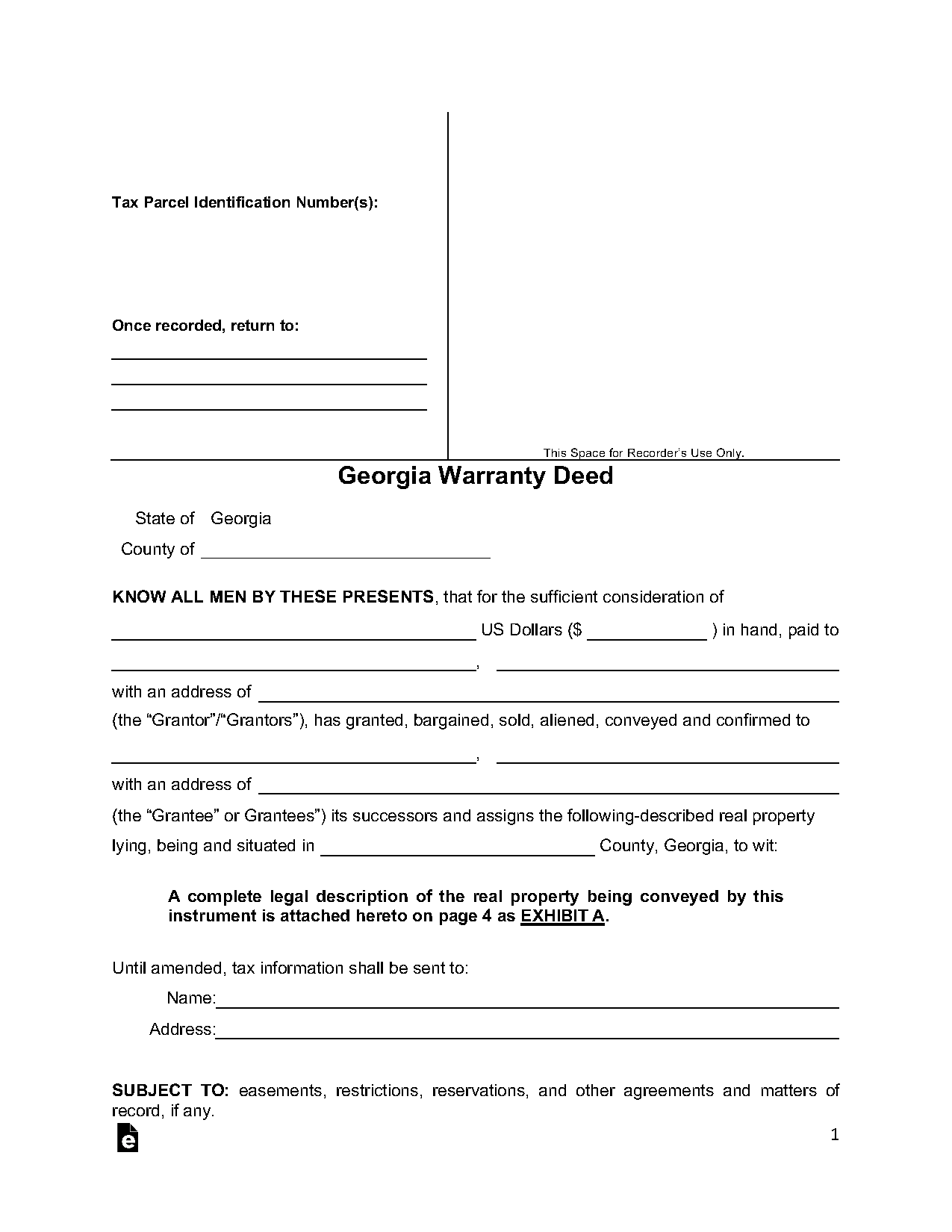
[GA] [GA] Which deed is used to give my house to my child?
Yes, a warranty deed can be appropriate for this situation—if your mother is transferring full ownership to you, and you plan to refinance the mortgage in your name afterward.
Here’s a breakdown to guide your next steps:
1. Warranty Deed – When to Use It
A warranty deed is typically used when the grantor (your mother) wants to:
- Transfer full ownership of the property
- Guarantee that she holds clear title to the property and will defend it against future claims
This is the strongest form of deed in Georgia, as it gives you the most protection.
2. Mortgage Issue – Due-on-Sale Clause
Most mortgages (especially conventional loans) include a “due-on-sale clause,” meaning:
-
If ownership is transferred (even to a child), the lender can call the full balance due immediately.
The deed transfer itself doesn’t relieve the debt. That’s why you must refinance afterward to pay off the current loan in full.
Make sure you don’t delay the refinance too long after the deed transfer to avoid lender enforcement action.
3. Steps to Complete the Deed Transfer in Georgia
A. Prepare the Warranty Deed – Georgia does not have a mandatory statewide form, but you must include:
- Legal description of the property
- Full names and addresses of both parties
- The granting clause and warranties
- Your mother’s notarized signature
B. Sign and Notarize – Must be signed in front of a notary public and one witness (Georgia law requires both).
C. File with the Clerk of Superior Court – Record the deed in the county where the property is located (Fulton County for Union City). There is a filing fee, usually $10–$25.
You may also need to file a PT-61 Real Estate Transfer Tax Form, which can be completed online through the Georgia Superior Court Clerks’ Cooperative Authority.
D. Notify the Mortgage Company – Be prepared for them to invoke the due-on-sale clause.
Coordinate the refinance process so you’re ready to satisfy the existing loan.
4. Important Considerations
- Title insurance: Optional but recommended to protect against title defects.
- Property taxes: You’ll take over responsibility after the deed is in your name.
- Insurance: Switch the homeowner’s policy into your name once the deed is recorded.
0
General Warranty Deed
Full Conversation
My mother has property in Georgia that she wants to give to me. There is a remaining balance on the mortgage that I would like to assume, but because of the type of loan, I cannot assume the loan. I have been given information on how to transfer the deed over to me through a warranty deed, and from there I can refinance the loan. Is the warranty deed form the appropriate form to use for this type of situation?
Lexi, Chatbot
I understand your situation. Have you consulted with a real estate lawyer in Union City, Georgia regarding the transfer of the property through a warranty deed?
No, I am trying to complete the form myself. Is that appropriate?
Lexi, Chatbot
Do you know if there are any specific requirements or restrictions related to assuming the loan on the property in Georgia?
I am not assuming the loan, because the lender does not allow that option. I am attempting to have my name added to the deed so that I am able to refinance the loan.
Lexi, Chatbot
Is there anything else the real estate lawyer should know before I connect you? Rest assured they’ll be able to help with adding your name to the deed.
No, that's all.
Andres Sanchez
Hello, my name is Andres Sanchez, and I’m an attorney with 20 years of experience. Please give me a minute to review your question. How are you?
I'm great. Thank you for taking the time to respond.
Andres Sanchez
Yes, a warranty deed can be appropriate for this situation—if your mother is transferring full ownership to you, and you plan to refinance the mortgage in your name afterward.
Here’s a breakdown to guide your next steps:
1. Warranty Deed – When to Use It
A warranty deed is typically used when the grantor (your mother) wants to:
- Transfer full ownership of the property
- Guarantee that she holds clear title to the property and will defend it against future claims
This is the strongest form of deed in Georgia, as it gives you the most protection.
2. Mortgage Issue – Due-on-Sale Clause
Most mortgages (especially conventional loans) include a “due-on-sale clause,” meaning:
-
If ownership is transferred (even to a child), the lender can call the full balance due immediately.
The deed transfer itself doesn’t relieve the debt. That’s why you must refinance afterward to pay off the current loan in full.
Make sure you don’t delay the refinance too long after the deed transfer to avoid lender enforcement action.
3. Steps to Complete the Deed Transfer in Georgia
A. Prepare the Warranty Deed – Georgia does not have a mandatory statewide form, but you must include:
- Legal description of the property
- Full names and addresses of both parties
- The granting clause and warranties
- Your mother’s notarized signature
B. Sign and Notarize – Must be signed in front of a notary public and one witness (Georgia law requires both).
C. File with the Clerk of Superior Court – Record the deed in the county where the property is located (Fulton County for Union City). There is a filing fee, usually $10–$25.
You may also need to file a PT-61 Real Estate Transfer Tax Form, which can be completed online through the Georgia Superior Court Clerks’ Cooperative Authority.
D. Notify the Mortgage Company – Be prepared for them to invoke the due-on-sale clause.
Coordinate the refinance process so you’re ready to satisfy the existing loan.
4. Important Considerations
- Title insurance: Optional but recommended to protect against title defects.
- Property taxes: You’ll take over responsibility after the deed is in your name.
- Insurance: Switch the homeowner’s policy into your name once the deed is recorded.
When I notify the mortgage company of the change to the deed, what happens then? Could I refinance through them or through another bank? How does that work?
Andres Sanchez
Great question—and you’re wise to think this through before notifying the mortgage company.
Here’s how this typically plays out in Georgia (and in most states):
What Happens When You Notify the Mortgage Company
If you notify the lender that your mother transferred the property to you via warranty deed, they will likely:
- Check the loan agreement for a due-on-sale clause (most mortgages have this).
- Trigger the clause, which allows them to demand immediate payoff of the loan.
In practice:
- Some lenders are flexible and won’t immediately call the loan due, especially if payments are current.
- Others will send a notice requiring payoff within 30–60 days or risk foreclosure.
So you must be ready to refinance quickly.
Can You Refinance With the Same Lender?
Yes—but it’s not guaranteed.
A. Refinancing With the Same Mortgage Company
- May be faster since they already hold the loan and property info.
- They’ll treat it like a new mortgage application, meaning you must qualify (credit, income, DTI ratio, appraisal, etc.).
- You’ll get new terms (interest rate, term length, closing costs).
Pro Tip: Ask before the deed transfer if they’re open to you refinancing with them and when they would enforce the due-on-sale clause.
B. Refinancing Through a Different Bank
- You can absolutely refinance with any lender you choose.
- They’ll run a full mortgage application as if you’re purchasing a home (even though you’re not).
- You’ll use the recorded warranty deed to show you have legal title to the home.
How to Time It Right
To minimize risk:
- Get pre-approved for a refinance loan before you record the deed.
- Coordinate with your mom and lender to close the refinance as soon as possible after recording the deed.
- Do not delay notifying the mortgage company once the deed is recorded, as they will see the public record eventually.
Got it. Thank you.
Andres Sanchez
You’re welcome. I hope everything works out for you.
11
2
Answered 3 days ago
Disclaimer
By messaging AskaLawyer.com, you agree to our Terms and have read our Privacy Policy.
The information provided on AskaLawyer.com is for general informational purposes only and does not constitute legal advice. While we strive to ensure the accuracy and timeliness of the information presented, we make no guarantees regarding its completeness or applicability to your specific circumstances.
Use of this website does not create an attorney-client relationship between you and AskaLawyer.com or any of its attorneys. Communications through this website, including any responses from attorneys, are not privileged or confidential. For advice tailored to your individual situation, we recommend consulting a licensed attorney in your jurisdiction.
AskaLawyer.com disclaims any liability for actions taken or not taken based on the content of this site. We are not responsible for any third-party content that may be accessed through this website. Reliance on any information provided herein is solely at your own risk.