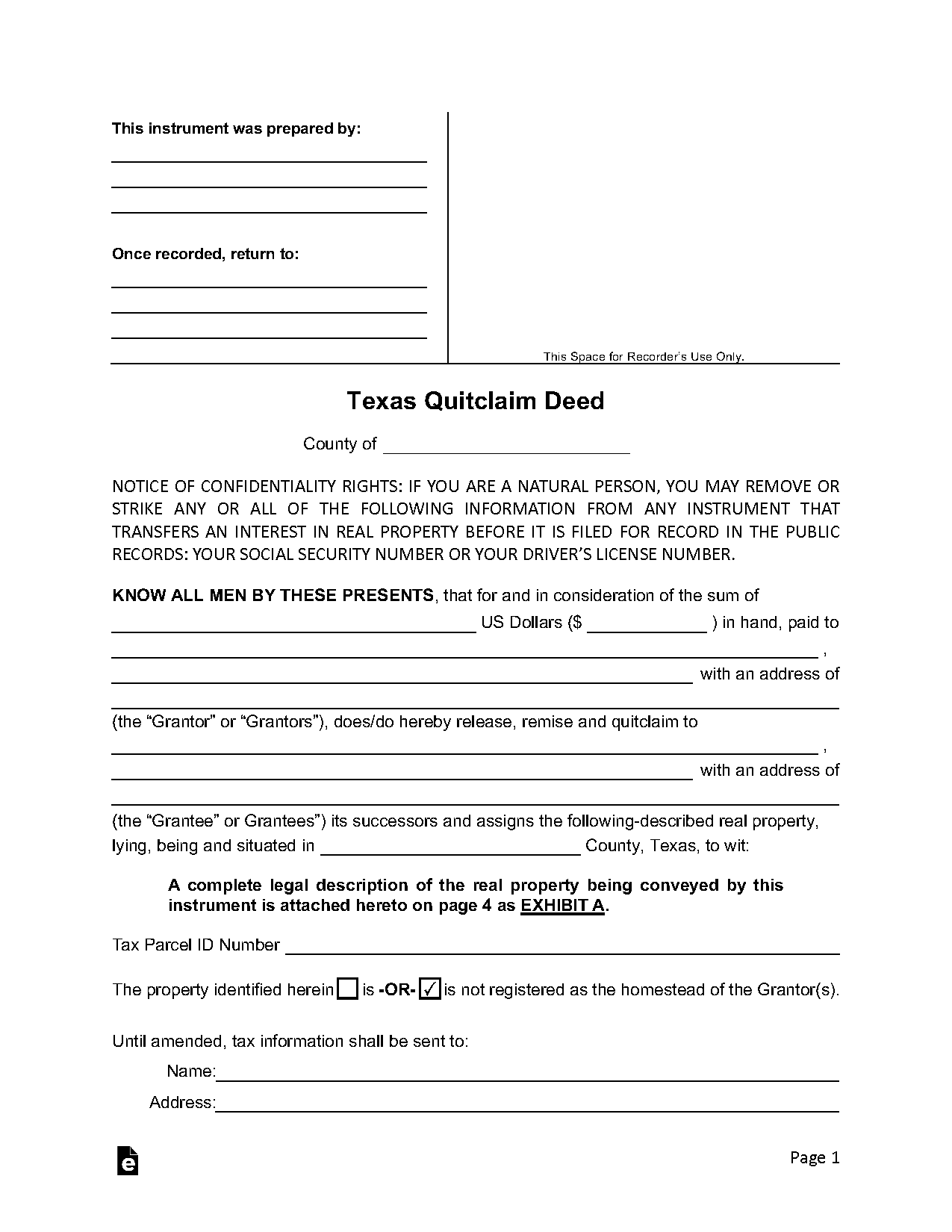
[TX] Should I use a special warranty deed or quit claim deed to transfer ownership?
Yes, the notary state can be crossed out and filled in by the notary.
You can use either a Special Warranty Deed or a Quitclaim Deed. They both transfer title to the grantee.
Here’s the difference:
A. Special Warranty Deed
- Limited guarantee – grantor guarantees no encumbrances during their ownership
- Provides some warranties
- More protection than a quitclaim
B. Quitclaim Deed
- No warranties at all
- Grantor conveys whatever interest they have
- Common between family, trusted parties, co-owners, divorcing spouses
- Often the simplest option
Given your situation, transferring between co-owners with clear title, a Quitclaim Deed is the most common method.
0
Texas Quit Claim Deed Form
Full Conversation
I am co-owner in a Texas home that is being deeded over to me. We are getting it notarized in Washington State. The paperwork shows Texas—how do I change that? Also do I need a Special Warranty Deed or just a Quit Deed form? The house has a clear title and we own it outright, no loans on it etc.
Lexi, Chatbot
I understand the situation regarding the deed transfer mix-up. Have you already signed the paperwork with the incorrect state listed?
No.
Lexi, Chatbot
Are you looking to correct the state listed on the deed and determine whether a Special Warranty Deed or Quitclaim Deed is more appropriate for this transfer?
Yes, it will be notarized in Washington State. Which is the right form to use? Will the Special Warranty Deed be sufficient or do we need to do a Quit Deed instead?
Lexi, Chatbot
Is there anything else the Real Estate Lawyer should know before I connect you? Rest assured they’ll be able to help with your deed transfer.
No.
Lori
Hey there! Welcome! I'm Lori, an attorney with many years of experience, and I'm here to help you. I am on live with you today.
What city/state is the real property located in?
Are you signing it in WA? The paperwork should reflect where you are signing it for the notary. If you are signing it and having it notarized in WA, then the notary block should reflect that.
Property is in Dallas, TX.
We are physically located in Seattle, WA.
My question also asked which form is legally needed for this transfer of ownership?
Person A and Person B are both on the deed, Person A is signing his 1/2 to Person B. Should the form be a Special Warranty Deed or a Quitclaim Deed?
Also, on the Special Warranty form it doesn't allow you to change state from TX to WA. On the notary page I didn't see where you could change the state from Texas to Washington, unless that can be crossed out by my notary.
Lori
Yes, the notary state can be crossed out and filled in by the notary.
You can use either a Special Warranty Deed or a Quitclaim Deed. They both transfer title to the grantee.
Here’s the difference:
A. Special Warranty Deed
- Limited guarantee – grantor guarantees no encumbrances during their ownership
- Provides some warranties
- More protection than a quitclaim
B. Quitclaim Deed
- No warranties at all
- Grantor conveys whatever interest they have
- Common between family, trusted parties, co-owners, divorcing spouses
- Often the simplest option
Given your situation, transferring between co-owners with clear title, a Quitclaim Deed is the most common method.
Thank you Lori. So I am safe using a Special Warranty Deed for this and when I get to Texas to file it, Person B won’t have any problems filing it to secure it in her name?
Lori
Yes, that is correct.
11
2
Answered 3 days ago
Disclaimer
By messaging AskaLawyer.com, you agree to our Terms and have read our Privacy Policy.
The information provided on AskaLawyer.com is for general informational purposes only and does not constitute legal advice. While we strive to ensure the accuracy and timeliness of the information presented, we make no guarantees regarding its completeness or applicability to your specific circumstances.
Use of this website does not create an attorney-client relationship between you and AskaLawyer.com or any of its attorneys. Communications through this website, including any responses from attorneys, are not privileged or confidential. For advice tailored to your individual situation, we recommend consulting a licensed attorney in your jurisdiction.
AskaLawyer.com disclaims any liability for actions taken or not taken based on the content of this site. We are not responsible for any third-party content that may be accessed through this website. Reliance on any information provided herein is solely at your own risk.